
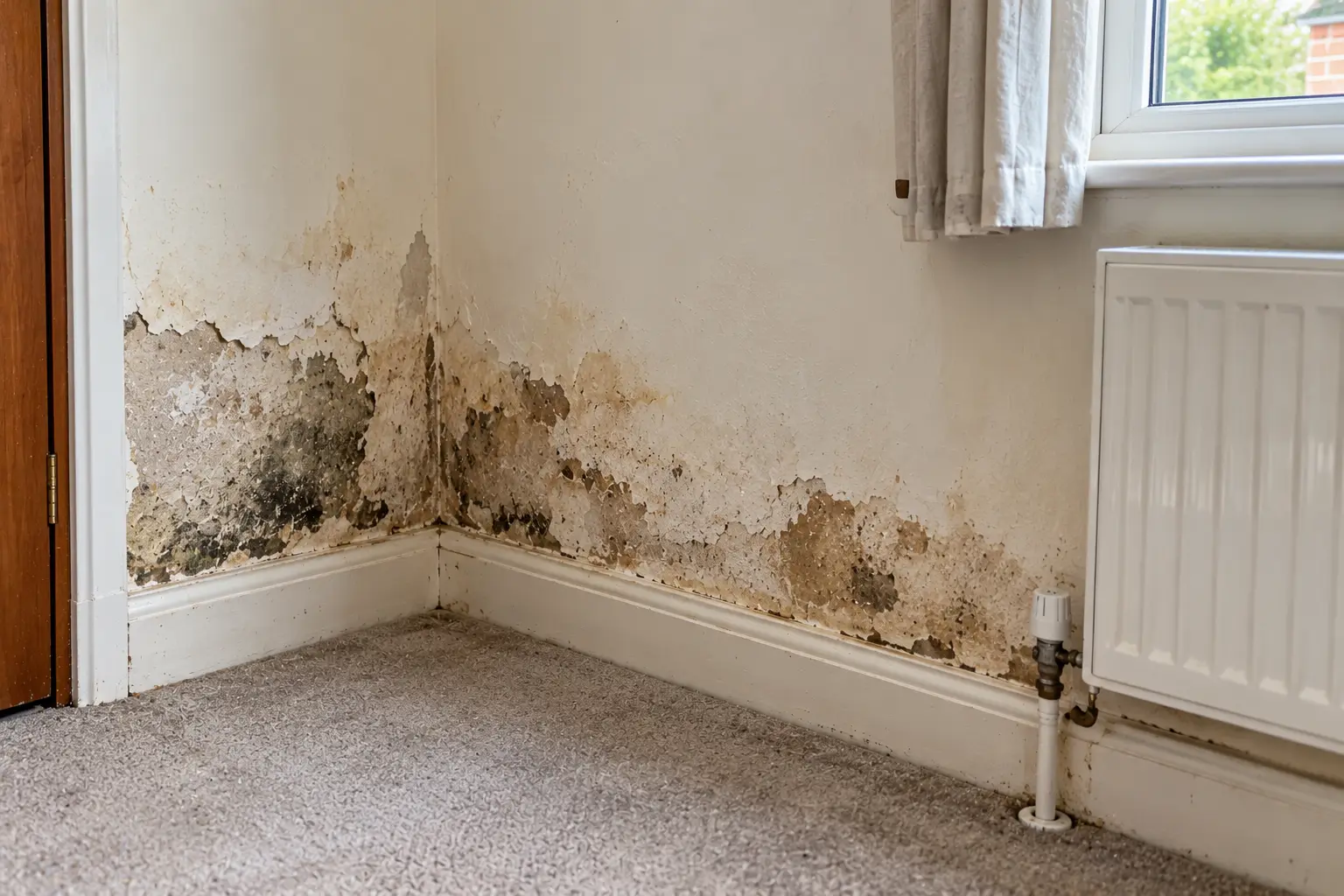
Damp in Rickmansworth’s valley homes
Rickmansworth sits where the Colne, Chess and Gade meet, alongside the Grand Union Canal and the Aquadrome lakes. That setting makes wet ground and moisture-laden valley air relevant when investigating damp, but proximity to water alone does not explain a damp wall.
Victorian terraces near the town centre and interwar homes on low, wet ground can present different problems. Older damp proof courses may have deteriorated, while raised paths or later alterations can allow moisture to bypass an otherwise effective barrier.
For homeowners in WD3, within Three Rivers, Hertfordshire, the useful question is how moisture reaches the affected surface. Ground moisture, rainwater and condensation need different responses, even when each leaves damaged decoration.
Rising damp, original DPCs and plaster repairs
Rising damp is moisture moving upwards through porous masonry from the ground. Possible signs include low-level staining, deteriorating plaster and salt deposits, although none of these proves rising damp on its own. Our rising damp treatment page explains the problem in more detail.
An original damp proof course, or DPC, may have failed or become bridged by external paving, soil or plaster. Identifying a bridge matters: injecting a new course without addressing the bypassing route may leave the underlying problem unresolved.
DPC injection can form a new barrier where it is appropriate for the wall construction and diagnosis. Salt-resistant replastering may also be needed because salts left in old plaster can continue attracting moisture after the source has been addressed.
Damp Pro and Co uses a BBA approved damp proofing system. Completed DPC work comes with a 20-year guarantee certificate; that guarantee applies to DPC work, not other treatments.
Rain getting through walls and around openings
Penetrating damp comes from water entering the building rather than rising from the ground. On terraces and interwar houses, sensible checks include leaking gutters, damaged downpipes, open mortar joints, cracked render and gaps around window frames.
A patch that worsens after rain can be a useful clue, especially beneath guttering or around an exposed opening. Water can travel within the structure, however, so the visible mark may not sit directly beside the defect.
The priority is to identify and address the entry route, rather than simply cover the stain. Read about penetrating damp treatment for the distinction between stopping incoming water and dealing with affected internal finishes.
Condensation in a moisture-heavy setting
Valley air is part of the local picture, but indoor moisture and cold surfaces still need careful consideration. Condensation forms when moist air meets a sufficiently cold surface; windows, external corners and walls behind furniture are common places to notice it.
Cooking, bathing and drying washing indoors add moisture. Keeping existing extract fans working, using lids on pans and allowing air to circulate behind furniture can help, though persistent mould deserves investigation rather than repeated cleaning alone.
Damp Pro and Co provides condensation control and mould treatment, and can recommend ventilation improvements. A new DPC is not a remedy for condensation, which is why separating the causes matters before choosing work.
Starting with a free damp survey
To arrange a free, no-obligation damp survey, call and describe the rooms affected, the position of the marks and when you first noticed them. Mention any connection with rainfall, colder weather or changes to paving outside.
A useful damp assessment considers the pattern of damage alongside the building’s construction and possible moisture routes. Moisture readings need context; one high reading alone cannot reliably distinguish rising damp from condensation or rain penetration.
The purpose is to establish what needs attention before selecting treatment. Keep affected areas accessible where practical, and avoid redecorating just before the visit, as visible staining and salts can provide useful clues.
Coming to Rickmansworth from Ruislip
Run by Seth Long, Damp Pro and Co is based at 8 Manor Road, Ruislip HA4 7LB. The business has over 30 years' experience, with PCA trained and Safeguard Ltd trained technicians.
Rickmansworth visits are made from Ruislip. For nearby enquiries around Croxley Green or Moor Park, contact us to discuss the location; information is also available for Northwood and damp proofing in Chorleywood.
Call 07803 253337 or freephone 0800 593 0300. We are open 24 hours, 7 days.
Rickmansworth: common questions
Does living near the Aquadrome mean I have rising damp?
No. Nearby lakes and wet ground are relevant background, but the moisture route must be established. Condensation and rain penetration can produce similar-looking damage.
Can raised paving bridge an existing DPC?
Yes. Paving or soil can allow moisture to bypass the barrier. Checking external levels helps establish whether bridging, rather than failure of the course itself, is involved.
Will damp plaster always need replacing?
Not always. Its condition and any salt contamination matter. Salt-resistant replastering may be appropriate following rising damp treatment, but replacement should follow the diagnosis.
Is every treatment covered for 20 years?
No. The 20-year guarantee certificate applies only to completed damp proof course work. It does not cover condensation control, mould treatment or other work.
Is there an obligation after the survey?
No. The damp survey is free and no-obligation. You can arrange it by calling 07803 253337 or freephone 0800 593 0300.