
SL9 on the Chiltern slopes
The postcode reaches across three wards: Gerrards Cross & Denham, Chalfont St Peter, and Farnhams & Stoke Poges. The ground falls away along the Chiltern slopes, with the River Misbourne off to the north-east.
On sloping plots, some houses sit below the road and others above their own gardens. Where land rises against a back wall, or a drive tips towards the front door, surface water ends up at the base of the masonry. Watch where it runs in a heavy shower and tell us; it often explains a damp patch better than anything inside.
A downhill wall that stays wet is not automatically a failed damp course either. Soil banked above it, a blocked channel drain or a path laid too high can all keep it damp, and those are usually cheaper to put right.
Houses from the 1950s: check the roof
Faulty roof tiles on a batch of 1950s houses led to the House of Lords ruling in Young & Marten Ltd v McManus Childs Ltd. The case was about those specific tiles, and it says nothing about any particular roof in the town today. What is true is that homes of that period are about 70 years old.
So when damp shows on a bedroom ceiling or the top of a wall, the roof and gutters deserve a look before anything lower down. From the garden you can often see slipped or cracked tiles, heavy moss, or dark streaks below a gutter. Photograph what you safely can, and note whether the stain grows after rain.
Our penetrating damp treatment page explains how water coming in from above is traced back to where it enters.
Early homes after the station opened
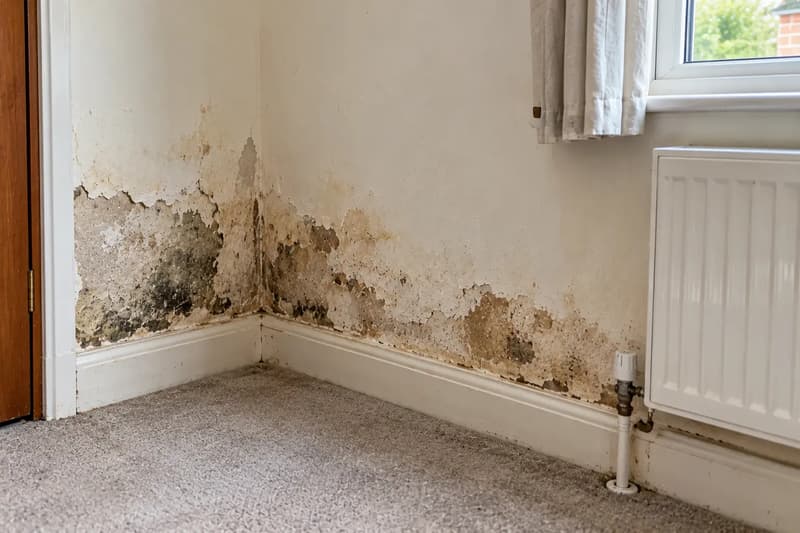
The first houses built after 1906 may keep their original damp courses and ventilation. Before treatment is even discussed, we look for bridging, where render, soil or a raised path carries moisture past the damp course, and for airbricks that have been covered or blocked. Read more on rising damp treatment in Gerrards Cross and damp proofing in Gerrards Cross.
Heating, mould and the water supply
Buckinghamshire's Census 2021 figures put 73.5% of households on mains gas alone, 8.1% on electric heating and 5.3% on oil. They describe the county, not SL9 specifically. A home that is hard or expensive to heat often has cold rooms, and cold rooms are where condensation and mould settle; see condensation control and mould treatment.
Affinity Water's postcode lookup for SL9 7QL returns 282 mg/l, which it classes as hard. Scale on taps and kettles is a nuisance rather than damp, though a furred-up fitting that leaks can wet a wall, so mention any plumbing near a stain.
What we will ask at booking
Expect a few questions: roughly when the house was built, whether the damp is high or low on the wall, whether it changes with rain or with cold weather, and what has changed outside recently. Those answers decide whether the visit starts on the roof line, at ground level or indoors.
The team and how to reach us
Seth Long heads Damp Pro and Co from 8 Manor Road, Ruislip HA4 7LB, bringing more than 30 years' experience. PCA and Safeguard Ltd have both trained the technicians who carry out the work.
Damp proof courses are installed with a BBA approved system, and each completed DPC is backed by a 20-year guarantee certificate limited to that DPC work. Lines on 07803 253337 and freephone 0800 593 0300 open every hour of every day, or request your free survey.
Gerrards Cross: common questions
My 1950s house has a damp bedroom ceiling. Could it be the roof?
It is a sensible first suspect. Roof covering and gutters are checked before anything lower.
Does the court case mean my roof is faulty?
No. It concerned particular tiles on certain 1950s houses, not any home today.
Do you cover all of SL9?
Yes, Chalfont St Peter and nearby Denham included.
Is Gerrards Cross water hard?
Yes. Affinity Water gives 282 mg/l for SL9 7QL.
Is Gerrards Cross in London?
No, Buckinghamshire.