
Floor of the valley, or its slopes?
A Wycombe address says a lot before anyone arrives. Down on the valley floor, Victorian terraces are often built with solid walls, and the problems that turn up there tend to be low-level or rain-driven. Up the sides of the valley, estates from the 1930s to the 1960s more often struggle with condensation.
So a terrace survey usually begins at the base of the wall: outside ground levels, the condition of any original damp course, and whether breathable brick has been covered with a modern sealing finish. On a hillside estate home, attention swings indoors to heating, extraction, double glazing and the corners where mould gathers.
Neither pattern is a rule, and a valley-side house can still have a defective gutter. Treat the location as a sensible first question, not an answer. Our rising damp treatment in High Wycombe and damp proofing in High Wycombe pages go further into each.
A buried river and chalky water
Between 1965 and 1967 the River Wye was put into a culvert through the town. Its water, like the tap supply, carries plenty of chalk, and the mains here is hard. Over years that hardness furs up valves and compression fittings until one begins to weep.
A slow drip inside a wall or under a floor can produce a stain that looks just like building damp. That is why, in this town, plumbing is one of the first things we eliminate. If your patch is close to a bathroom, kitchen or radiator, tell us at booking; checking a joint is far cheaper than treating a wall that was never the problem.
Keeping rooms warm enough
At county level, Census 2021 shows 5.3% of Buckinghamshire households heating with oil and 8.1% with electricity. Those numbers cover the whole county rather than Wycombe itself, but they are a reminder that not every home has cheap, even heat.
Rooms that stay cool give warm, moist air a cold surface to condense on, and mould follows. If one bedroom or a north-facing wall is always the problem, note it. Our condensation control and mould treatment services deal with both the moisture and the growth it leaves.
Signs worth recording before the visit
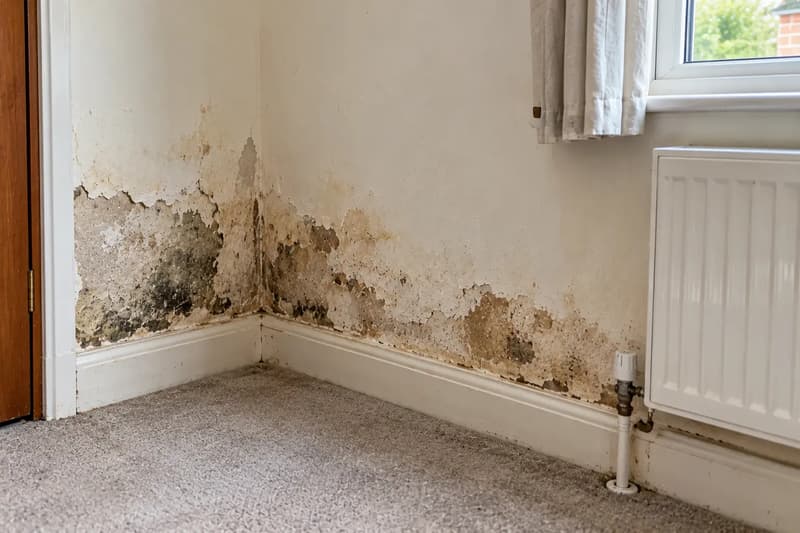
A short record makes the survey sharper. Write down when the marks first appeared, whether they grow after rain or during a cold spell, and whether any recent decorating has covered them. Photographs a week or two apart are especially useful on terraces, where a rising tide line and a rain-fed patch can look similar on a single day.
Also note anything done to the outside: a new patio, rendered panels, repointing with hard mortar, or blocked vents. Changes like these often explain why a wall that was dry for decades has started to show damp.
Getting to you, and planning
We come out along the M40, covering streets from the centre to areas around Cressex Park and Ride. Buckinghamshire Council handles planning for the town, so visible external work on a listed building or in a conservation area may need its agreement. Let us know if either applies and we will recommend repairs with that in mind.
Who will survey your home
Damp Pro and Co belongs to Seth Long and is based at 8 Manor Road, Ruislip HA4 7LB. Over 30 years in the trade sit behind it, with technicians who completed PCA and Safeguard Ltd training.
If a damp proof course turns out to be the fix, the system used is BBA approved, and completed DPC jobs come with a 20-year guarantee certificate that covers that DPC work and nothing else. Phone 07803 253337, or 0800 593 0300 free, any hour of any day, or book your free survey here, mentioning whether you are on the valley floor or a slope.
High Wycombe: common questions
Does it matter if I live on the valley floor?
It shapes the first checks. Valley terraces lean towards wall-base and rain issues; slope estates towards condensation.
Could a plumbing leak be mistaken for damp?
Yes. Chalky water scales fittings over time, so a weeping joint is ruled out early.
Do you cover all of High Wycombe?
Yes, the town and its surrounding suburbs.
Is High Wycombe part of London?
No. It is a Buckinghamshire town.
Which council handles planning?
Buckinghamshire Council.