
Workers' terraces and solid walls
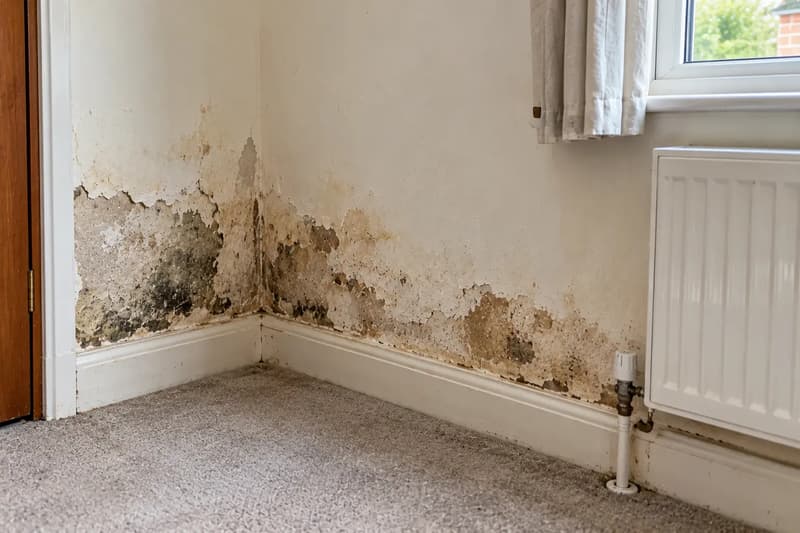
The factory terraces are generally built with solid brick, one thickness of masonry between room and weather. Walls like that can take on water from below and from outside, so both possibilities are kept open until the evidence points one way. Pointing, gutters, outside ground levels and the base of the wall are examined before any treatment is suggested; see penetrating damp treatment and rising damp treatment in High Wycombe.
Look along the front of a terrace and you will often see where neighbours have done different things: one house repointed in hard mortar, another rendered, a third painted. Those changes affect how each wall dries. If yours has been coated or rendered, tell us roughly when, because damp that began after the work is a strong clue.
Rear yards matter too. Many have been concreted over the years, sometimes to a level above the inside floor, which pushes splashback and standing water against the back wall.
Hillside estates
Higher up the valley, the estates suffer condensation more often than ground moisture. Mould along cold walls and window frames is usually a question of airflow and indoor humidity; see condensation control.
In these homes, ask yourself whether the mould is worst in winter, worst in bedrooms first thing in the morning, or worst behind furniture against outside walls. Yes to any of those points towards condensation rather than a building defect.
Shared student houses
Near the university, houses with several occupants generate a great deal of moisture from showers, cooking and laundry dried indoors. Mould is a frequent result; see mould treatment and landlord damp and mould.
Landlords can help by noting how many people live in the house, whether bathroom and kitchen fans work and vent outside, and how the heating is set. That usually tells us more than the mould itself.
County figures from Census 2021 show 17.8% of Buckinghamshire homes are terraced and 15.7% of households rent privately; they are not Wycombe-specific.
Districts we visit
Suburbs we cover include Booker, Bowerdean, Castlefield, Cressex, Daws Hill, Micklefield, Terriers, Totteridge, Downley and Wycombe Marsh, around The Rye. Buckinghamshire Council deals with planning across the town.
When the cause is a pipe
Wycombe's water is chalky and hard, and over the years scale builds up in fittings until a joint begins to seep. A slow drip behind a bath panel or under a radiator produces a patch indistinguishable at first glance from building damp.
If a stain is anywhere near plumbing, say so when you book. Checking a fitting costs nothing and may save an unnecessary wall treatment.
What happens on the day
The visit starts with your account of the problem, then moves outside to the walls, ground and rainwater goods before coming back in to take readings and look at ventilation. You get an explanation of the likely cause and what, if anything, needs doing.
Arranging a visit
Damp Pro and Co is owned by Seth Long and run from 8 Manor Road, Ruislip HA4 7LB; we reach the town along the M40. More than 30 years in the trade underpin each survey, carried out by technicians who trained with the PCA and Safeguard Ltd.
Damp proof courses we install use a BBA approved system, and every completed DPC comes with a 20-year guarantee certificate restricted to that DPC work. Call 07803 253337 or 0800 593 0300 (freephone), staffed 24 hours on all seven days, or ask for your free survey.
High Wycombe: common questions
My terrace was built for furniture workers. Is it prone to damp?
Solid walls can take water from below or outside, so both routes are checked.
Why is there mould in my hillside home?
Usually condensation; the survey looks at airflow and moisture sources.
Can you help with a student let?
Yes. We identify why mould is forming and suggest a suitable fix.
Which postcodes do you cover?
HP11, HP12 and HP13.
Who handles planning in High Wycombe?
Buckinghamshire Council.