
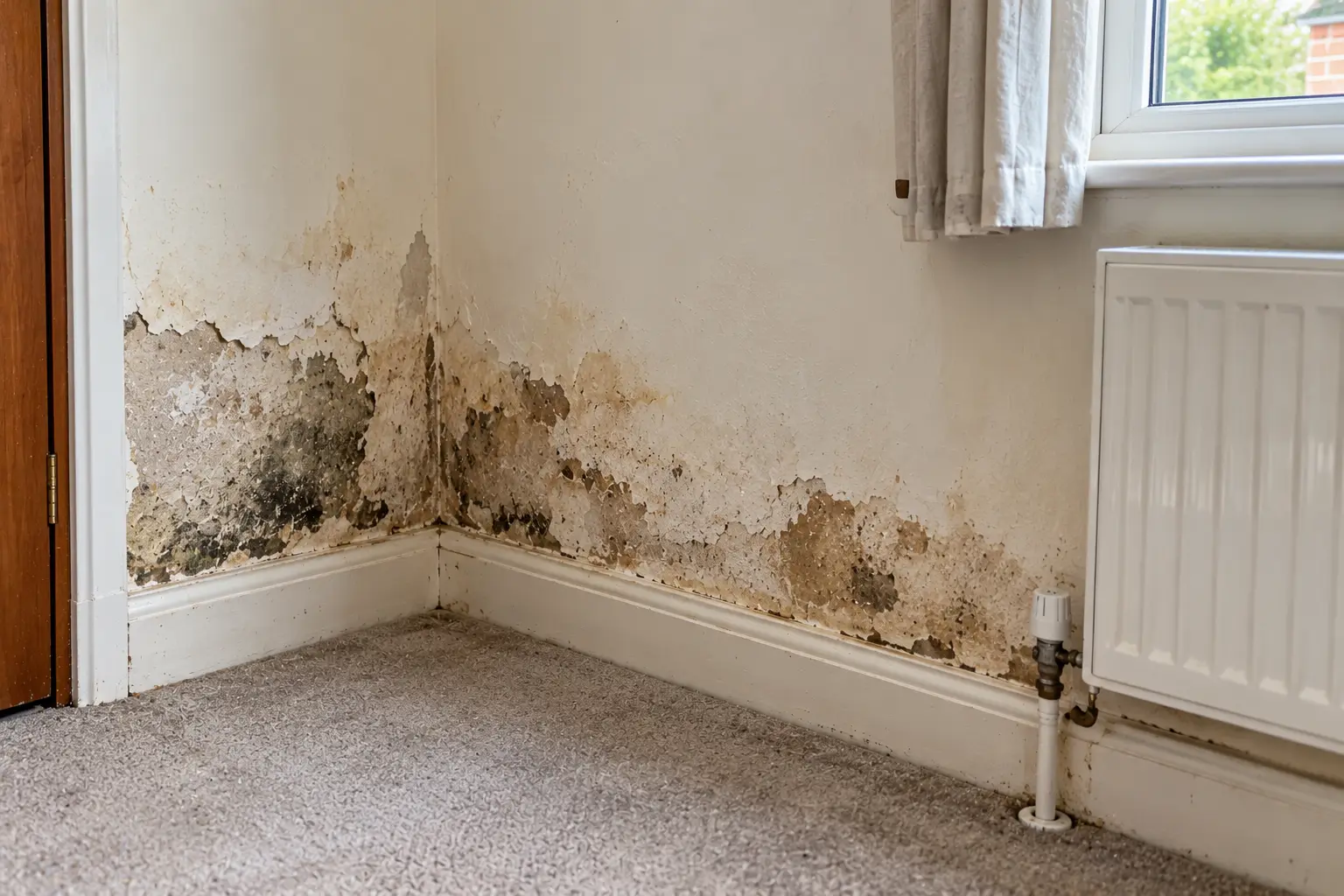
Penetrating damp is rainwater getting into your home through the walls, roof or openings. Unlike rising damp, it can appear at any height, and it usually gets worse after heavy rain. We trace it to the source and put it right.
Common causes of penetrating damp
Penetrating damp nearly always has a building defect behind it. The causes we find most often are:
- Leaking or blocked gutters and downpipes
- Cracked render or eroded brick pointing
- Porous or spalled bricks on exposed walls
- Failed seals around windows and doors
- Defective flashing around chimneys and roofs
- Bridged cavities in cavity-walled homes
- Garden soil or paths banked against walls
Signs to look out for
Damp patches that grow after rain, sometimes high up near ceilings or around window reveals, are a classic sign. You may see brown staining, bubbling plaster, mould on one wall only, or water trickling down inside a chimney breast.
Penetrating damp is often blamed on rising damp or condensation, which leads to the wrong work being done. That is why we always start with a careful survey.
How we treat penetrating damp
Our approach is to stop the water first, then repair the damage.
Find the entry point
We inspect inside and out, take moisture readings and check gutters, pointing, render and openings to find where water is getting in.
Fix the defect
We recommend and carry out repairs such as repointing, render repairs, resealing or water-repellent treatments to masonry as appropriate.
Repair the inside
Once the wall is protected, damaged plaster is removed and the wall is replastered and made ready for decoration.
Common signs we're called out for
Damp patches that appear or darken after heavy rain are the most common reason homeowners call us. Where they sit, and when they get worse, says a lot about the source; our guide to wet patches on walls explains how to read them.
Hairline or wider cracks and hollow areas in cracked render can draw rain into the wall behind and stop it drying, showing as damp inside on exposed elevations.
Brick faces flaking or crumbling away usually mean brickwork has stayed wet for too long, often under a leaking gutter or downpipe. Our guide to spalling bricks covers the causes and repairs.
Damp on external walls of a cavity-walled home after insulation was added can mean water is crossing the cavity. Our guide to cavity wall insulation and damp explains how this is diagnosed.
Expert help you can trust
With over 30 years' experience, PCA trained and Safeguard Ltd trained technicians, and ratings of 9.82 on Checkatrade from 389 reviews and 4.9 on Google, we will give you a clear, honest answer about what is causing your damp.
Penetrating damp treatment questions
Is penetrating damp the same as rising damp?
No. Penetrating damp comes from outside, usually rain, and can occur at any height. Rising damp comes from the ground and stays low on the wall.
Will a new damp proof course fix penetrating damp?
No. A DPC only stops moisture rising from the ground. Penetrating damp needs the entry point fixed.
Can cavity wall insulation cause damp?
It can on exposed walls, or where the outer brickwork lets in a lot of rain, because the insulation may carry water across the cavity. Other causes are ruled out first; see our guide to cavity wall insulation and damp.
Damp proofing in your area
- Damp proofing in Ruislip
- Damp proofing in Harrow
- Damp proofing in Ealing
- Damp proofing in Wembley
- Damp proofing in Pinner
- Damp proofing in Northwood
- Damp proofing in Ickenham
- Damp proofing in Uxbridge
- Damp proofing in Hillingdon
- Damp proofing in Hayes
- Damp proofing in Southall
- Damp proofing in Greenford
- Damp proofing in Northolt
- Damp proofing in Stanmore
- Damp proofing in Denham
- Damp proofing in Gerrards Cross
- Damp proofing in Beaconsfield
- Damp proofing in High Wycombe