
Written by Seth Long, Damp Pro and Co · Last updated: 7 October 2026
Read the patch: location, shape and timing
Before reaching for a paintbrush or a dehumidifier, spend a week or two watching the patch. Three things tell you most. First, its height: is it close to the floor, halfway up, or near the ceiling? Second, its outline: a level band along a wall behaves differently from a round stain or a streak running down from a corner. Third, its timing: does it darken after a downpour, after a bath upstairs, or stay much the same whatever the weather?
Draw round the edge lightly in pencil and date it. Take a photo in the same light each time. Within a fortnight you will usually see whether it is spreading, shrinking, or rising and falling with the rain. That record saves time when you describe the problem to anyone, whether a plumber, a roofer or a damp specialist.
Low on the wall with a tide mark
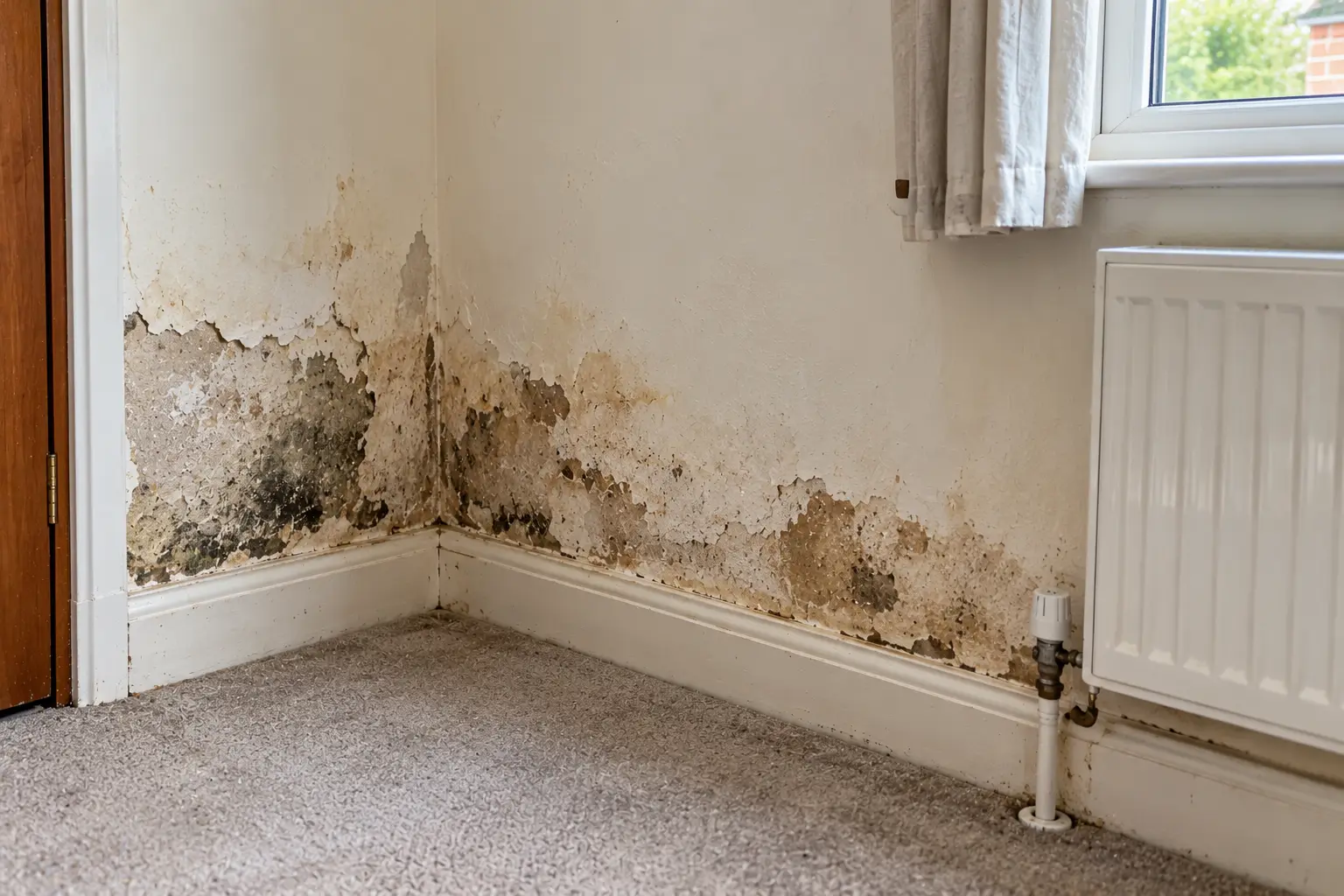
A damp band reaching up from the skirting, often topped by a brown line and with powdery salts on the surface, is the pattern associated with moisture coming up from the ground. It tends to run along a length of ground-floor wall rather than appearing as a single spot, and it rarely climbs much above a metre.
That pattern can come from a failed or missing damp proof course, but also from ground or paving that has been raised over it. Our guide to the signs of rising damp goes through the clues in detail, and a check outside for bridging is always worthwhile before deciding on treatment.
High up, or after rain
A patch that appears or darkens after heavy rain, especially one higher up the wall, near a ceiling or below a window, usually means water is getting in from outside. This is penetrating damp. It can affect any floor of the house and often shows on the wall that faces the prevailing weather.
The source is normally a defect you can see from outside. Overflowing or cracked gutters, leaking downpipe joints, worn-out pointing, cracked render and damaged flashings are the usual suspects. Patches under a chimney breast or along the top of a wall can point to problems with the roof or chimney. Our guide to cracked render and penetrating damp explains how one of the most common routes works.
Around windows and doors
Damp that frames a window or door, collecting at the corners of the reveal or below the sill, often comes from the joint between the frame and the wall. Sealant shrinks and cracks over time, and a sill without a working drip groove lets water run back under it into the brickwork.
Check the outside sealant for gaps, see whether the sill slopes away from the wall, and look for a missing or blocked drip underneath. Small defects here can let in a surprising amount of water during wind-driven rain. Damp on the window glass itself is a different matter: that is condensation, and our types of damp guide sets out how it differs.
Sudden or spreading patches
If a patch appears quickly, keeps spreading regardless of the weather, or sits below a bathroom, kitchen, radiator or water tank, suspect plumbing first. A weeping pipe joint, a failed shower seal or a leaking waste can soak a wall or ceiling within days.
In that case call a plumber before anyone else. Turning off the water and checking whether your meter keeps moving can confirm a hidden leak. Once the leak is repaired, the wall can be left to dry and any damaged plaster assessed afterwards.
What a specialist checks
A damp specialist looks at the house inside and out. Moisture readings are taken across the affected wall and compared with dry areas, so the pattern can be mapped rather than judged by eye. Outside, the checks cover gutters, downpipes, pointing, render, sills and openings, as well as ground levels against the base of the wall.
Meter readings alone are not proof of a cause; they are read alongside the pattern, the construction of the wall and what is happening outside. Where water is getting in from outside, our penetrating damp treatment involves repairs such as repointing, render repairs, resealing or water-repellent treatments, then replastering. Call Seth on 07803 253337 or freephone 0800 593 0300 to talk through what you are seeing.
Questions about this topic
Why is my wall wet after rain?
Rain is probably getting into the wall through a defect outside, such as a gutter, pointing, render or a sill. That is penetrating damp.
Can a leaking gutter cause damp inside?
Yes. Water that overflows or leaks from a gutter can soak the same section of wall repeatedly until it shows indoors.
How can I tell a leak from damp?
A plumbing leak usually spreads fast whatever the weather and sits near pipes or wet rooms. Damp from outside tends to follow the rain.
Is water coming through a wall serious?
It should not be left. Ongoing wetting can damage plaster and decoration, so find and repair the source early.
Will the patch dry out by itself?
Only once the source is stopped. A wall can take a long time to dry, and salt-damaged plaster may still need replacing.
Related guides
- Cracked render and damp
How cracked or hollow render lets rain in, why hard render traps moisture and how repairs are decided.
- Signs of rising damp
Tide marks, salty plaster, lifting skirting and the outside checks that show whether damp is rising from the ground.
- Types of damp
Rising, penetrating and condensation damp side by side: causes, where each appears and how each is treated.