
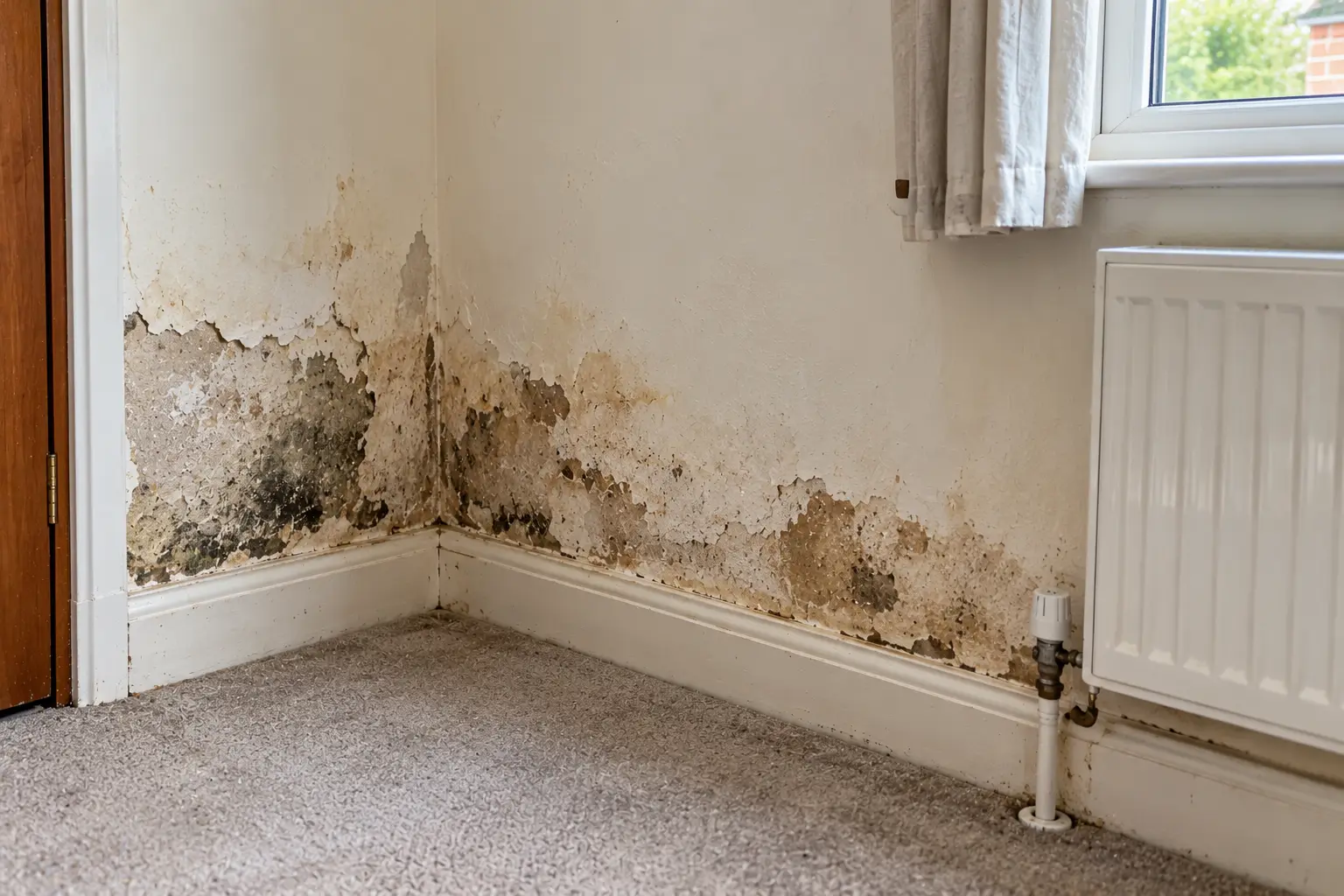
Rising damp is groundwater drawn up through brick and mortar when a wall's damp proof course has failed, been bridged or was never installed. It is our main specialism, and with over 30 years' experience we have treated it in thousands of homes across West London and South Bucks.
What is rising damp?
Bricks and mortar are porous. Without an effective barrier, moisture in the ground travels upward through the tiny pores in the masonry, a process called capillary action. It typically rises up to around 1 metre before evaporation balances it out.
As the water evaporates it leaves behind salts carried up from the ground. These salts absorb moisture from the air, which is why plaster in affected rooms can stay damp even in dry weather and why simply repainting never solves the problem.
Signs of rising damp in your home
Rising damp has a distinctive pattern. The most common signs we find on surveys are:
- A tide mark or stain up to about 1 metre above the floor
- Peeling wallpaper and blistering paint low on the wall
- Crumbling, powdery or salt-stained plaster
- Skirting boards that are swollen, stained or coming away
- A musty smell in ground floor rooms
- Damp that is worse in winter and near external walls
How we treat rising damp
Every treatment starts with a proper diagnosis, because condensation and penetrating damp are often mistaken for rising damp. If rising damp is confirmed, our process is:
1. Free survey and moisture readings
A trained technician inspects the walls, checks external ground levels and takes readings to map exactly where moisture is rising.
2. Remove salt-contaminated plaster
Affected plaster is hacked off, usually to around 1 metre, so the new course and new plaster can do their job.
3. Inject a new damp proof course
We drill the mortar course and inject our BBA approved damp proofing system, which forms a water-repellent barrier within the wall.
4. Replaster with a salt-resistant system
Walls are finished with Safeguard's Dryzone damp-resistant plaster system, designed to hold back residual salts while the wall dries – and ready to paint in as little as 2 to 5 days.
5. Guarantee
On completion you receive a 20-year guarantee certificate for the treatment.
Why choose Damp Pro and Co
Our technicians are PCA trained and Safeguard Ltd trained, and we use a BBA approved damp proofing system. We are rated 9.82 on Checkatrade from 389 reviews and 4.9 on Google, and we answer the phone 24 hours a day.
We will always tell you honestly if rising damp is not the problem. If lowering a flowerbed or clearing an air brick will fix it, we will say so. Raised ground can mean a bridged damp proof course rather than a failed one.
Rising damp treatment questions
How long does rising damp treatment take?
Most rooms are treated in one to three days, depending on the length of wall and plastering needed. We confirm timings after the survey.
How soon can I decorate?
With the Dryzone damp-resistant plaster system we use, walls are typically ready to paint within 2 to 5 days. We will confirm for your job.
Is the treatment guaranteed?
Yes. On completion you receive a 20-year guarantee certificate.
Rising damp treatment in your area
- Rising damp treatment in Ruislip
- Rising damp treatment in Harrow
- Rising damp treatment in Ealing
- Rising damp treatment in Wembley
- Rising damp treatment in Pinner
- Rising damp treatment in Northwood
- Rising damp treatment in Ickenham
- Rising damp treatment in Uxbridge
- Rising damp treatment in Hillingdon
- Rising damp treatment in Hayes
- Rising damp treatment in Southall
- Rising damp treatment in Greenford
- Rising damp treatment in Northolt
- Rising damp treatment in Stanmore
- Rising damp treatment in Denham
- Rising damp treatment in Gerrards Cross
- Rising damp treatment in Beaconsfield
- Rising damp treatment in High Wycombe