
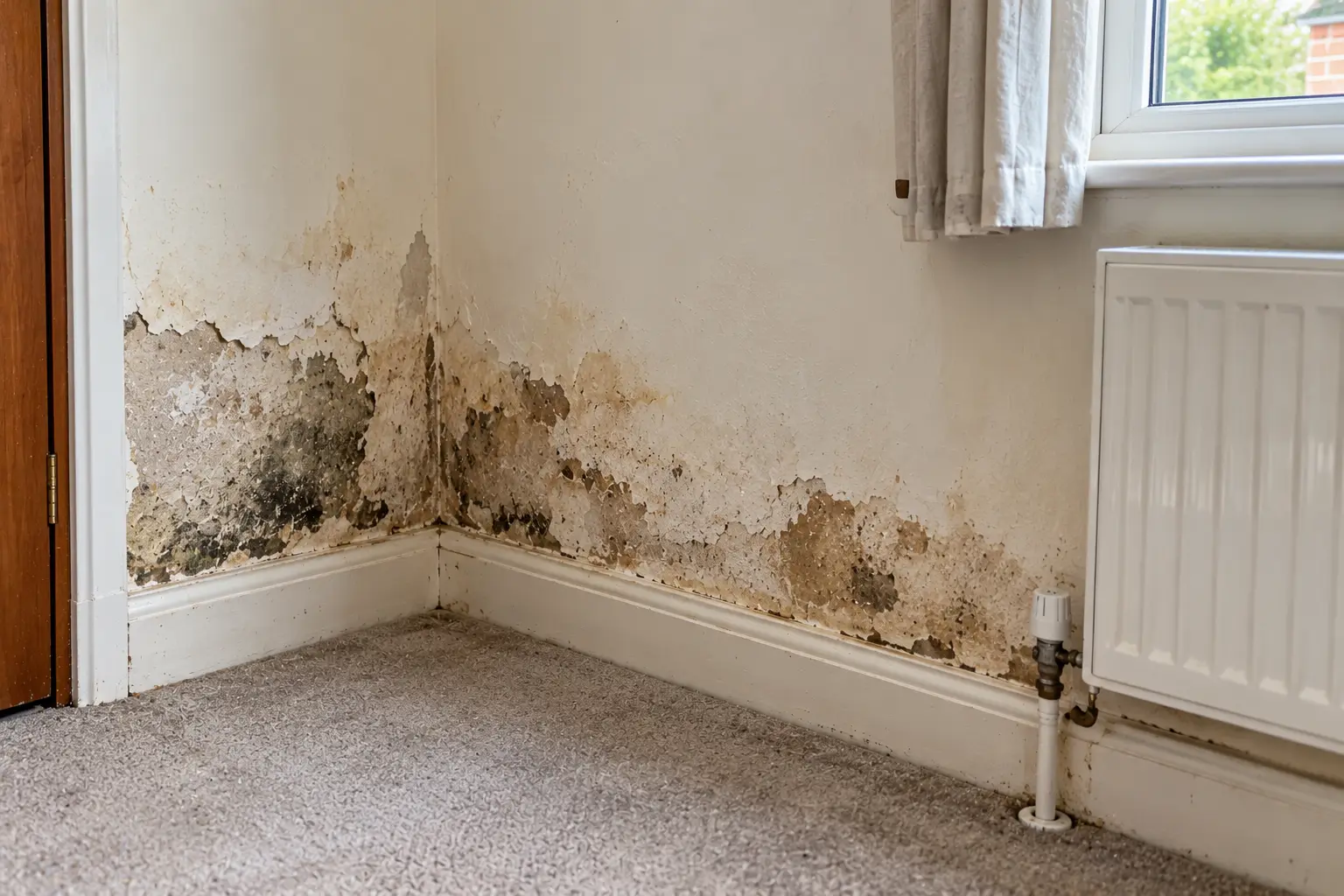
Why Ickenham homes can develop rising damp
Ickenham’s older cottages around the village pond and St Giles Church sit alongside interwar semis, detached houses and post-war bungalows. Some early buildings may have no physical damp proof course, while later homes can have original slate or bitumen barriers whose condition needs checking.
Ground levels matter too. Low-lying gardens towards Ickenham Marsh and the River Pinn can remain wet through winter, increasing moisture exposure at the foot of walls. Wet ground does not prove rising damp, but it makes an effective, unbridged damp proof course particularly important.
Based in Ruislip, roughly two miles north-east, we work with homeowners across Ickenham, UB10, in the London Borough of Hillingdon. Our Ickenham area page provides the local overview.
Look for bridges before assuming the DPC has failed
A damp proof course, or DPC, interrupts moisture moving upwards through masonry. Even an intact barrier can be bypassed if a patio, raised bed or accumulated soil reaches above it. Render plinths extending across the DPC can also provide a route around the barrier.
In an Ickenham semi with a replacement solid floor, the junction between floor and wall deserves attention. An unsuitable junction can allow moisture to bypass the wall’s protection. Simply injecting another course without considering these details may leave the underlying problem unresolved.
Where bridging is responsible, correcting ground levels or the affected detail may be more appropriate than installing a new DPC. The decision should follow inspection rather than the age of the house alone.
How the survey checks for rising damp
We assess the pattern of damage, take moisture readings at different positions and heights, and examine accessible wall bases and external levels. A single high meter reading is not a diagnosis: salts, materials and the distribution of moisture all need to be considered.
The survey also rules out condensation, penetrating damp and plumbing leaks before attributing the problem to rising damp.
Tide marks, loose skirting and powdery deposits help build the picture, but none is conclusive on its own. Our guide to signs of rising damp explains what to look for before arranging a visit.
DPC cream injection where a new barrier is needed
Where the wall construction and diagnosis support it, DPC cream is injected into a line of drilled holes in the mortar bed. The cream forms a water-repellent barrier intended to limit moisture rising through the masonry. Wall thickness, construction and continuity at adjoining walls affect the treatment layout.
Damp Pro and Co uses a BBA approved damp proofing system, with PCA trained and Safeguard Ltd trained technicians and over 30 years' experience. Read more about our rising damp treatment, or see the separate damp proofing page for Ickenham.
Salt-resistant replastering and drying
Moisture rising through masonry can carry salts into plaster. Those deposits may continue attracting moisture after the source has been addressed, so affected plaster can need removal and replacement with a suitable salt-resistant specification.
Replastering is not a substitute for controlling the moisture source. The extent of removal depends on the damage and salt contamination, rather than an arbitrary patch around the visible stain.
Walls need time to dry after treatment. Thick cottage walls may dry differently from the masonry in an interwar semi, so decoration should follow the drying condition and the requirements of the plaster system.
Arrange an Ickenham rising damp survey
Damp Pro and Co is run by Seth Long from 8 Manor Road, Ruislip HA4 7LB. Completed damp proof course work comes with a 20-year guarantee certificate; this guarantee applies to DPC work, not other work.
Call 07803 253337 or freephone 0800 593 0300 to arrange your free, no-obligation survey. We are open 24 hours, 7 days.
Ickenham: common questions
Could an older Ickenham cottage have no DPC?
Yes. Some older cottages predate physical damp courses, but their absence alone does not establish that treatment is necessary.
Can a raised patio cause rising damp in my Ickenham semi?
A patio above the DPC can bridge it. Checking levels should come before deciding that the original barrier needs replacement.
Does living near Ickenham Marsh mean I need an injected DPC?
No. Saturated ground increases exposure, but wall condition, existing protection and moisture patterns determine whether an injected course is appropriate.
Will my Ickenham home's stained plaster need replacing?
Possibly. Salt-contaminated plaster may need replacement even after treatment, while staining alone is not enough to decide the extent.
Is DPC work on an Ickenham house guaranteed?
Completed DPC work carries a 20-year guarantee certificate. This does not extend to replastering or other work.