
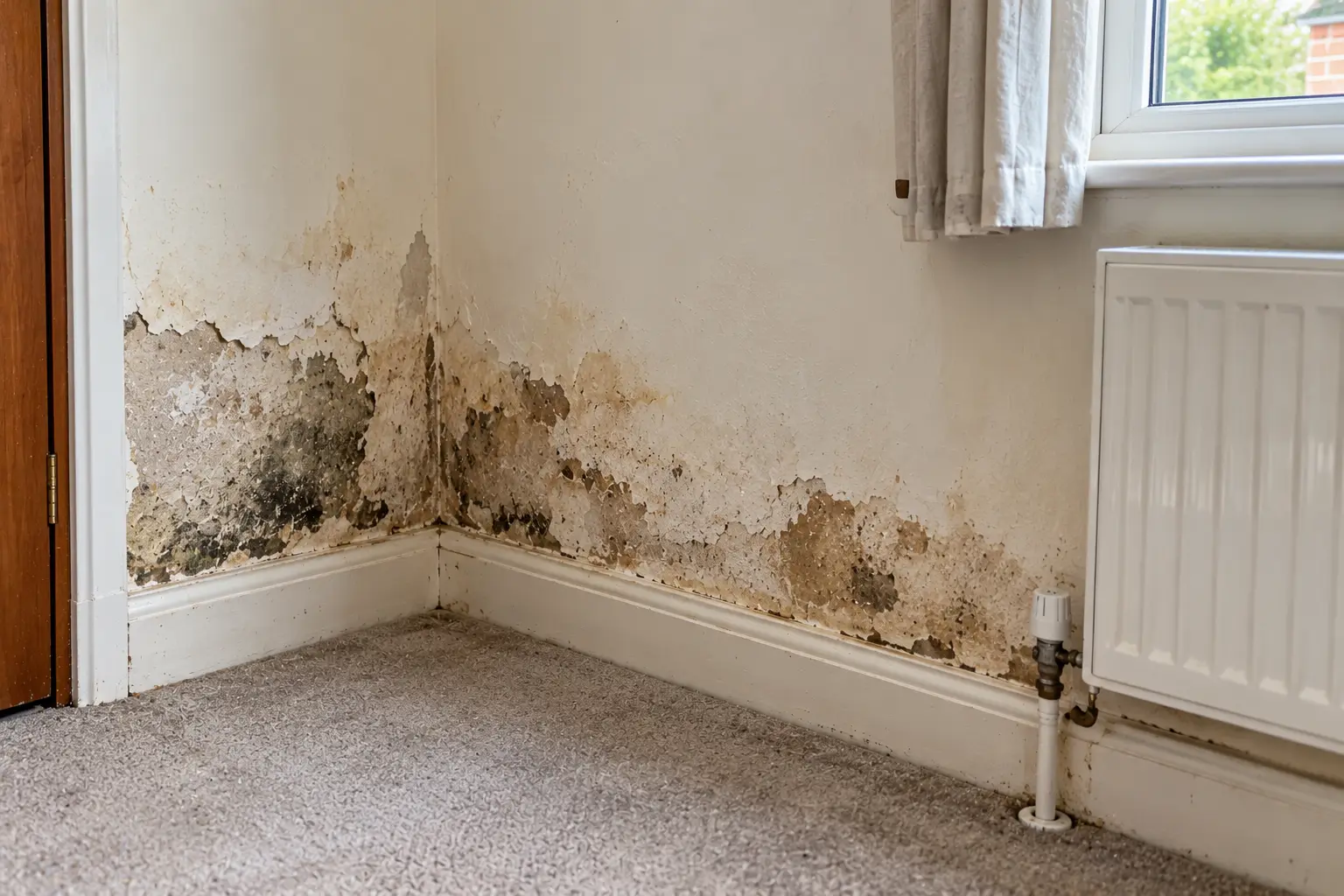
Why Beaconsfield walls need an individual assessment
Around London End and Wycombe End, Georgian brickwork and older flint cottages differ from the Edwardian and interwar houses near the station. Some older walls have no original damp proof course, while later properties may have slate or bitumen barriers whose condition needs checking rather than assuming they have failed.
Beaconsfield stands on high Chiltern ground, with clay and flints over chalk. Clay near foundations can hold moisture, but ground conditions alone do not establish rising damp. Wall construction, outside levels and the route moisture takes through the masonry matter more than a property's age or postcode.
Raised ground can bypass an existing DPC
A damp proof course forms a barrier against moisture moving upwards through masonry. Patios, raised flower beds or soil built up against a wall can bridge that barrier, allowing ground moisture to reach masonry above it. A render plinth extending across the DPC can create a similar route.
Changes indoors also deserve attention, particularly where a solid floor meets an older wall. An unsuitable floor-to-wall junction may allow moisture to bypass the intended protection. Resolving a bridge may be more appropriate than injecting another DPC, so the existing levels and junctions should be assessed first.
Diagnosis before deciding on treatment
Diagnosis brings together moisture readings at different heights, the pattern of damage and an examination of accessible wall bases and external ground levels. A high meter reading on its own is not proof: salts in plaster can affect readings, and the findings need to make sense together.
The survey rules out condensation, penetrating damp and plumbing leaks before attributing the damage to rising damp. Tide marks, deteriorating skirting and powdery deposits are useful clues rather than a diagnosis; our guide to signs of rising damp explains what homeowners can look for without removing plaster themselves.
DPC cream injection in suitable masonry
Where a new chemical DPC is appropriate, cream is injected through carefully positioned holes, usually along a mortar bed, to form a barrier against rising moisture. Wall thickness, construction and continuity of the proposed course affect the treatment specification. Irregular flint or mixed masonry should not be treated as a straightforward brick wall.
Damp Pro and Co uses a BBA approved damp proofing system, with PCA trained and Safeguard Ltd trained technicians and over 30 years' experience. Read about our rising damp treatment for the wider treatment approach. In listed Old Town homes, any necessary permissions should be checked before drilling or removing historic finishes.
Salt-resistant replastering and the DPC guarantee
Stopping moisture rising does not remove salts already carried into the wall. Contaminated plaster can continue to attract moisture, so affected areas may need removal and replacement with a suitable salt-resistant replastering specification. The choice of finish needs particular care on older brick and flint walls.
Walls also need time to dry; new plaster is not evidence that the masonry beneath is dry enough for decoration. Damp Pro and Co provides a 20-year guarantee certificate on completed damp proof course work. This guarantee applies to the DPC work only, not replastering or other work.
Arrange a Beaconsfield rising damp survey
Run by Seth Long, Damp Pro and Co is based at 8 Manor Road, Ruislip HA4 7LB, about 11 miles east of Beaconsfield. See our Beaconsfield area page and damp proofing in Beaconsfield for local service information.
Call 07803 253337 or freephone 0800 593 0300 to arrange a free, no-obligation damp survey. We are open 24 hours, 7 days.
Beaconsfield: common questions
Does an Old Town flint cottage need DPC injection?
Not automatically. Mixed flint and brick walls need assessment of their construction, moisture pattern and ground levels before a suitable treatment is chosen.
Can a patio bridge the DPC of a Beaconsfield house?
Yes, if its level allows moisture to bypass the barrier. Checking the patio against the existing DPC helps establish whether bridging needs correction.
Is an Edwardian New Town home's original DPC necessarily defective?
No. An original slate or bitumen DPC may still function. Age alone does not justify replacement; bridging and the source of moisture need checking.
Do salts on my Beaconsfield walls prove rising damp?
No. Salts support an assessment but are not conclusive alone. Moisture patterns, wall construction and the condition of plaster must also be considered.
What guarantee comes with DPC work in Beaconsfield?
Completed damp proof course work receives a 20-year guarantee certificate. The guarantee covers that DPC work only and does not extend to other work.