
Coaching inns and Georgian brick
The Old Town keeps its coaching inns and Georgian brick houses, many of them listed. Such buildings need breathable treatment, and listed building or conservation consent may be required before work begins.
Georgian brick was laid in soft lime mortar. Where later repointing used hard cement, water that once escaped through the joints is forced through the bricks instead, leading to damp patches inside and flaking faces outside. Note any repointing you know about.
Flint and Bath stone
Flint is the traditional Chilterns-edge material, and the 1869 church is flint with Bath stone dressings. Solid masonry like this suits lime-based methods that let moisture escape; cement render and impermeable coatings tend to trap it. For rain penetration, see penetrating damp treatment.
Damp in a flint wall usually tracks the weather and lines up with failing mortar, a sill or a gutter, rather than forming a level band near the floor.
Conservation areas, Article 4 and the Town Hall
Conservation areas cover Beaconsfield Old Town and Hampden Hill, with Article 4 directions over Beaconsfield and the Rectory Area. Outside render, tanking or added vents may need Buckinghamshire Council's consent. Beaconsfield Town Council meets at the Town Hall on Penn Road.
Raise any of this at booking. The recommendation can then fit the controls instead of being redrawn after a refusal.
Plumbing before walls
Affinity Water's supply here is about 288 mg/l, rated hard. Hard water furs fittings, and a scaled or seeping joint can leave a damp patch resembling a building fault, so leaks are ruled out early.
Countywide Census 2021 data show 34.3% of Buckinghamshire homes detached, 30.2% semi-detached and 5.3% of households heating with oil; these are not Beaconsfield's own figures.
New Town houses
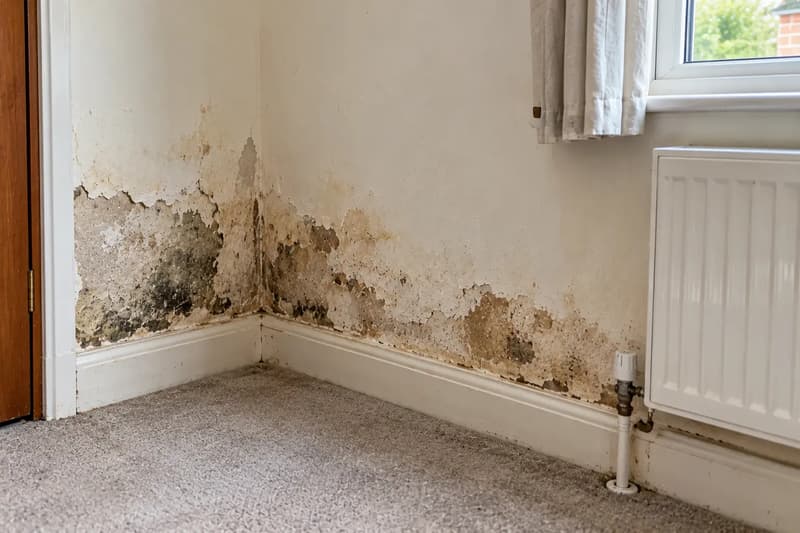
Homes near the Parades are later than the Old Town and are checked on their own terms: airbricks, floor ventilation, the damp course line and whether paths or patios have been raised since the house was built. Condensation is a frequent cause of mould in these homes too; see condensation control.
Before we visit
In an Old Town or listed house, note any cement render, masonry paint or sealant on old walls, which can hold moisture in traditional fabric. In a New Town home, make sure airbricks are clear.
If a patch sits near a bathroom or radiator, mention it; with water this hard, a weeping joint is a realistic suspect and free to rule out.
Booking in Beaconsfield
Damp Pro and Co is the business Seth Long runs from 8 Manor Road, Ruislip HA4 7LB, drawing on more than 30 years in damp work. Its technicians trained with the PCA and Safeguard Ltd.
When a damp proof course is installed we use a BBA approved system, and the completed DPC carries a 20-year guarantee certificate, covering that DPC work and nothing beyond it. Ring 07803 253337 or freephone 0800 593 0300, open around the clock daily, or request a free survey online.
Further along the Thames, we also work as damp proofing specialists in Marlow.
Beaconsfield: common questions
Can you damp proof a listed building in Beaconsfield Old Town?
We find the cause first and favour breathable repairs. Listed building consent may be needed, so check with Buckinghamshire Council.
Is a flint wall treated differently?
Yes. Flint and stone generally suit lime-based, breathable methods.
Does an Article 4 direction affect damp work?
It can restrict visible external changes, such as render or vents, in covered areas.
Could a damp patch be a plumbing leak?
Yes. With hard water, pipes are ruled out before building damp is diagnosed.
Is Beaconsfield in London?
No. It is in Buckinghamshire.