
Why Ruislip's older damp courses need checking
Ruislip's 1930s Metro-land semis and short terraces often have an original slate or bitumen damp proof course, usually shortened to DPC. Its age alone does not prove failure: the important question is whether it still forms a continuous barrier against moisture rising through the masonry.
Patios, raised flowerbeds and rendered plinths can bridge that barrier, allowing moisture to bypass it. Altered solid floors can also affect the junction between floor and wall. Near Manor Farm and St Martin's Church, older cottages may have no original DPC, so their construction needs particular care before choosing treatment.
Clay ground and low-level moisture
Much of Ruislip lies on London Clay, which can retain moisture for long periods. Lower ground around the River Pinn can also stay wet through winter. These conditions make ground levels and the protection at the base of walls worth checking, but they do not establish rising damp on their own.
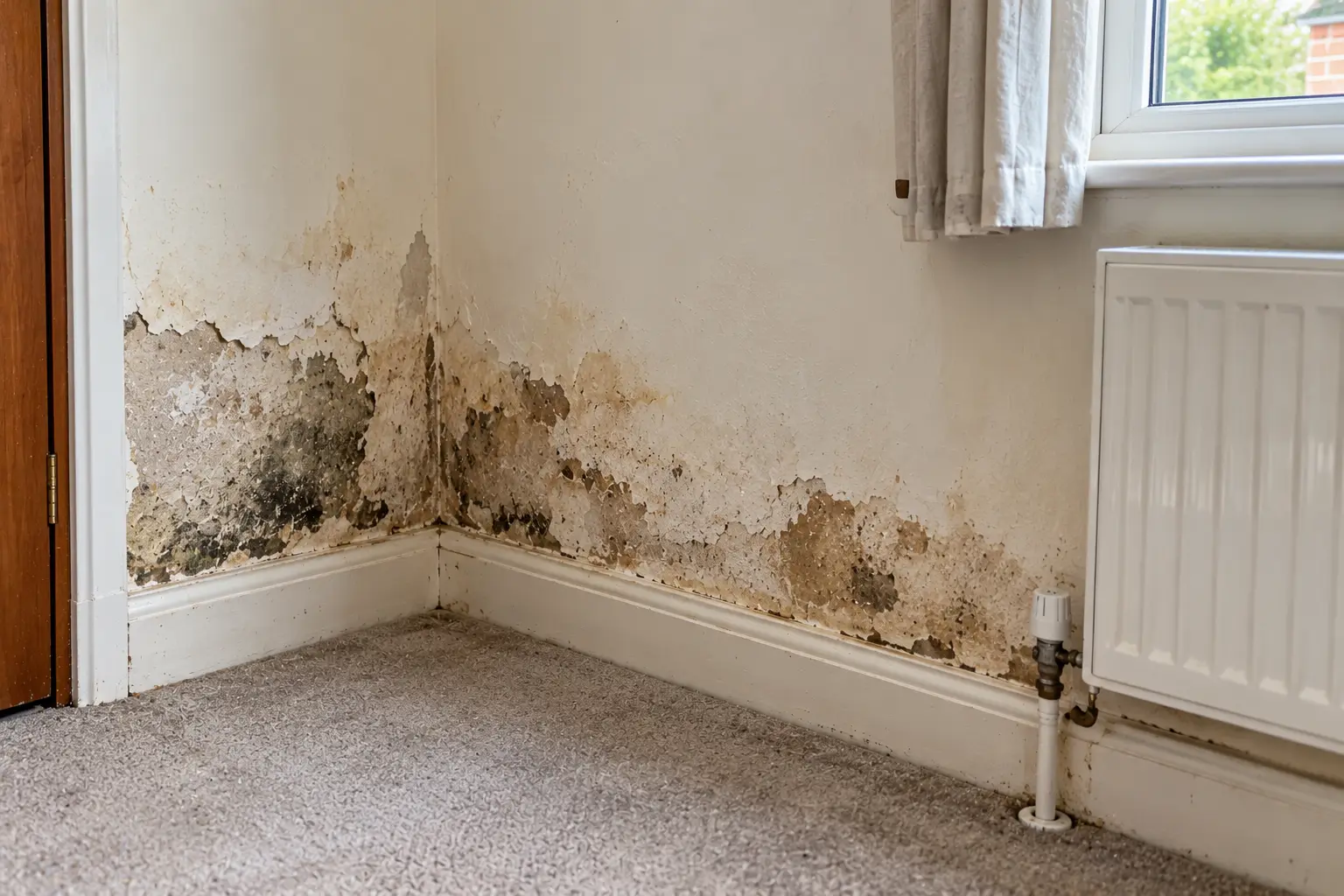
Look for deteriorating plaster, peeling finishes or a tide-like stain near skirting level. White salts can appear as moisture evaporates from masonry, although marks alone cannot identify the source. Our guide to signs of rising damp explains what to note before a survey.
Diagnosis before a treatment decision
Moisture readings need to be interpreted alongside the wall's construction, visible salts, external ground levels and any existing DPC. A high meter reading by itself is not enough to justify injection, particularly where salts may influence the result.
The survey rules out condensation, penetrating damp and plumbing leaks before identifying rising damp. Checking for bridging is equally important: a patio or render crossing the DPC may need attention rather than simply adding another barrier.
For local information, visit our Ruislip area page. Our Ruislip damp proofing page provides a separate overview, while this page focuses on moisture rising from the ground.
DPC cream injection where appropriate
Where a replacement chemical DPC is appropriate, cream is injected into a prepared line of holes in the mortar bed. It spreads into suitable masonry to form a water-repellent barrier against upward moisture movement. Wall thickness, construction and continuity of the treatment line matter.
Damp Pro and Co uses a BBA approved damp proofing system. Treatment should also account for any bridging, because an injected barrier cannot correct a raised bed or floor detail that allows moisture to pass around it. Read more about rising damp treatment before arranging your survey.
Salt-resistant replastering and drying
Stopping the moisture source does not remove salts already deposited in plaster. Contaminated finishes can continue to attract moisture, so salt-resistant replastering may be needed alongside DPC work. The extent should follow the condition of the plaster, rather than a stain's visible edge alone.
Walls need time to dry after treatment, with the drying period depending on thickness, moisture levels and finishes. Decorating too early can spoil new finishes. A 20-year guarantee certificate applies to completed damp proof course work only; it does not cover replastering or other work.
Arrange a survey from our Ruislip base
Damp Pro and Co is run by Seth Long at 8 Manor Road, Ruislip HA4 7LB. With over 30 years' experience, the business has PCA trained and Safeguard Ltd trained technicians.
Call 07803 253337 or freephone 0800 593 0300 to arrange a free, no-obligation damp survey. We are open 24 hours, 7 days.
Ruislip: common questions
Does my 1930s Ruislip semi automatically need a new DPC?
No. An original slate or bitumen course may still function. Its condition and possible bridging need checking before replacement is recommended.
Could a raised patio cause rising damp in my Ruislip Manor home?
A patio above the DPC can bridge it. Checking its height against the barrier helps establish whether ground-level changes are needed.
Is DPC cream suitable for an older cottage near St Martin's?
Suitability depends on the masonry and construction. Older or mixed walls need assessment rather than an assumption that injection is appropriate throughout.
Does living near the River Pinn prove my wall has rising damp?
No. Wet ground is relevant background, not a diagnosis. Moisture patterns, wall details and the existing barrier still need examination.
What guarantee comes with DPC work at my Ruislip home?
Completed damp proof course work comes with a 20-year guarantee certificate. This guarantee applies only to DPC work, not other treatment or finishes.