
Ninety feet of clay
When a well was sunk on the High Street in 1864, it passed through roughly 90 ft of clay before reaching chalk. That clay drains slowly, so lawns, borders and paths stay wet long after rain.
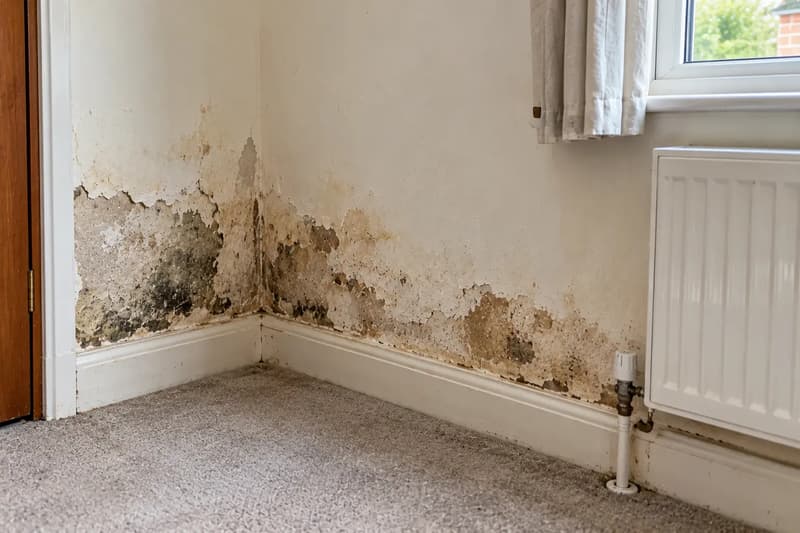
Before anybody uses the words rising damp, outside ground levels and drainage need checking. Soil piled against a wall, a patio laid above the damp course or a blocked gully can all keep the base of a wall wet with nothing wrong with the course itself.
A quick test you can do: after heavy rain, see how long water sits on paving next to the house. If puddles linger against the wall for hours, that water has nowhere to go but into the brickwork.
Metro-land houses at a century
Much of the suburb was built as Metro-land from the early 1900s. Houses from then may still rely on their first damp courses and airbricks, which can wear out or be bridged as gardens and paths are altered.
When a survey does confirm rising damp, rising damp treatment in Ruislip and the damp proof course page describe what is involved.
Often, though, the answer is simpler: clear an airbrick, lower a bed, cut back render that runs to the ground. Those are tried first because they cost less and deal with the actual cause.
Protected streets and older buildings
Ruislip Village and Ruislip Manor Way are conservation areas, Eastcote Village and Eastcote Park Estate lie close by, and Manor Farm stands near the village centre. Older buildings need remedies that let them breathe; impermeable finishes can trap water inside.
Hillingdon Council handles planning, so ask about consent before visible changes in a conservation area.
Semis, flats and condensation
Borough-wide Census 2021 numbers for Hillingdon show 35.1% of homes semi-detached and 30.9% flats, with 56.6% of households owning and 25.9% renting privately.
Mould on cold walls and around windows is normally about moisture and airflow; see condensation control. Rain coming through walls is covered by penetrating damp treatment.
In a semi, the side wall shared with no neighbour is usually the coldest, and mould often appears there first. In a flat, look at corners where an outside wall meets the ceiling.
What the survey checks first
Outside: ground and path levels, gullies, airbricks, render and gutters. Inside: where the marks sit, whether salts are present, readings at different heights, and how rooms are heated and ventilated. Plumbing near any stain is checked before conclusions are drawn.
Your neighbours on Manor Road
Seth Long runs Damp Pro and Co from 8 Manor Road, Ruislip HA4 7LB, right here in town, with more than 30 years' experience. Technicians on the team are PCA and Safeguard Ltd trained.
A BBA approved system is used for damp proof courses, and completed DPC installations are given a 20-year guarantee certificate that applies to that DPC work alone. Call 07803 253337 or freephone 0800 593 0300, open all day and night, every day, request a free survey or see our Ruislip area page.
Ruislip: common questions
Why does clay soil matter for damp in Ruislip?
It drains slowly, so high ground or poor drainage against a wall can keep it wet. That is checked before rising damp is considered.
My house near the Lido dates from the 1930s. Does it need a new DPC?
Not necessarily. Many original courses still work and are simply bridged. A survey confirms which.
Do you work in Ruislip Village conservation area?
Yes, with breathable repairs, and we suggest confirming consent with Hillingdon Council.
Is Ruislip in Harrow?
No. It is part of the London Borough of Hillingdon.
Where are you based?
On Manor Road in Ruislip, at number 8.