
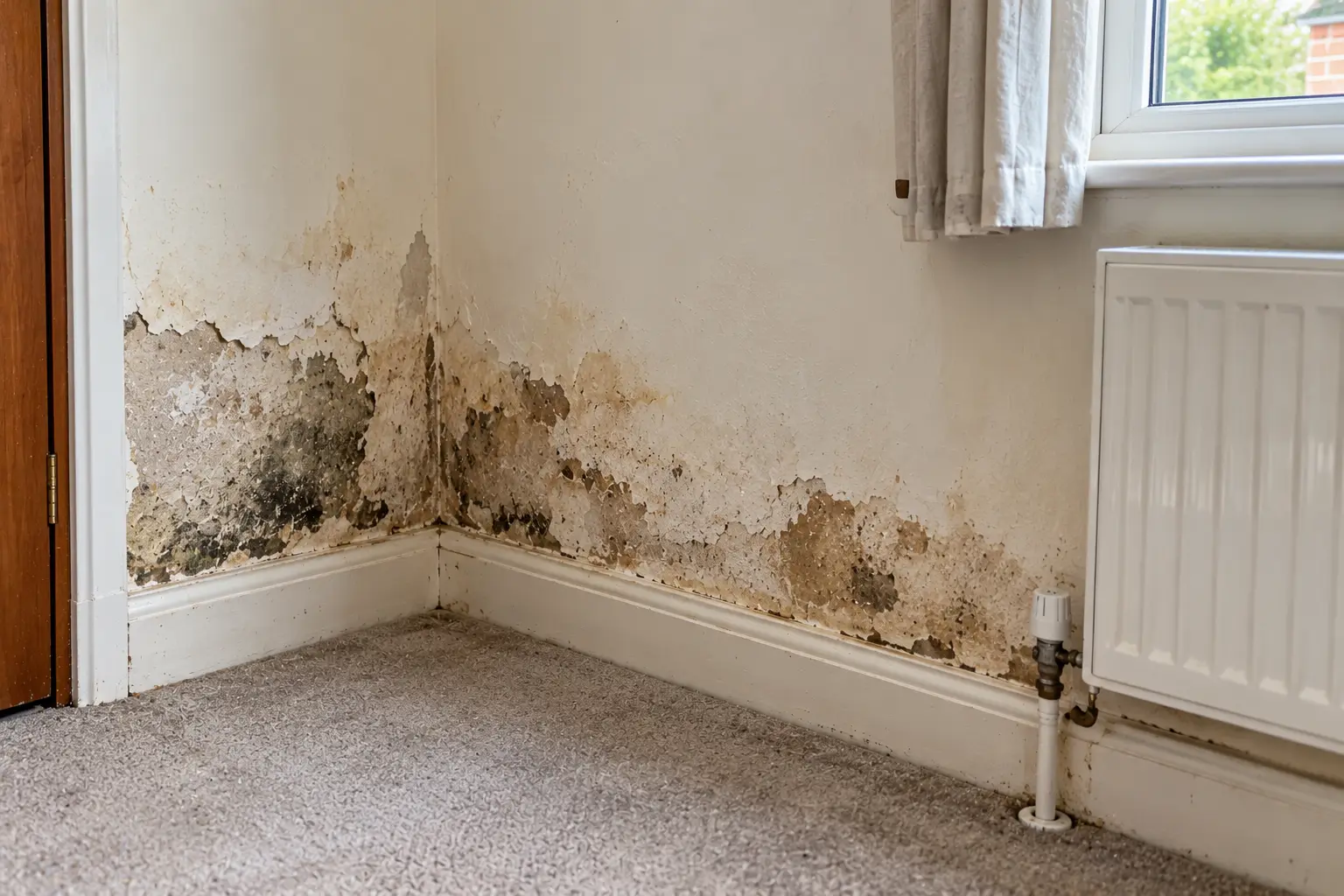
Why older Ealing walls can draw up moisture
The Victorian and Edwardian terraces around West Ealing and Northfields often have solid brick walls and suspended ground floors. Original slate or bitumen damp proof courses may remain effective, but gaps, damage or later alterations can leave routes for moisture to rise through masonry.
London Clay and the lower ground towards Hanwell and the River Brent can keep soil beside foundations damp for prolonged periods. That does not prove rising damp, but makes checking the wall’s moisture barrier important. Our Ealing area page provides wider local information.
Look for bridging before replacing a damp course
A patio, raised flower bed or render plinth can bridge an existing damp proof course, allowing moisture to bypass it. In a bay-fronted terrace, compare outside ground levels with the course rather than assuming the barrier has failed simply because the internal skirting is stained.
Later solid floors also need attention at the wall junction, particularly where a suspended floor has been replaced. Airbricks should remain clear where suspended floors survive, although blocked openings alone do not diagnose rising damp. Removing a bridge may be more appropriate than injecting another course.
How the survey checks for rising damp
Moisture readings help map the pattern across a wall and at different heights, but a meter reading alone is not proof. Diagnosis also considers salt deposits, plaster condition, outside levels and the position of any visible damp proof course. The survey rules out condensation, penetrating damp and leaks before recommending rising damp treatment.
In an Ealing flat conversion, access to the outside wall and ground-floor rooms may be needed to understand the source. Our guide to signs of rising damp explains what to record before the visit, including staining height and changes after alterations.
DPC cream injection where it is needed
Where a new chemical course is appropriate, DPC cream is injected into a drilled mortar joint to form a barrier against moisture rising through the masonry. Wall construction, thickness and adjoining floors affect the proposed position and specification. Bridging still needs addressing; injection should not substitute for correcting high ground levels.
Damp Pro and Co uses a BBA approved damp proofing system, with PCA trained and Safeguard Ltd trained technicians. Read about rising damp treatment for the general approach, or see our Ealing damp proofing page for the broader local service.
Salt-resistant plaster and time to dry
Rising moisture can carry ground salts into plaster. Once contaminated, that finish may continue attracting moisture even after the route from the ground has been controlled. Where necessary, affected plaster is removed and replaced with a salt-resistant specification suited to the treatment.
Walls do not dry immediately after injection, particularly thick solid walls in older Ealing houses. Redecoration should follow the drying and plastering advice for the chosen system rather than a fixed calendar date. A 20-year guarantee certificate applies to completed damp proof course work only, not replastering or other work.
Arrange an Ealing rising damp survey
Run by Seth Long, Damp Pro and Co is based at 8 Manor Road, Ruislip HA4 7LB, about seven miles north-west of Ealing. We work for homeowners and bring over 30 years' experience.
Call 07803 253337 or freephone 0800 593 0300 to arrange a free, no-obligation damp survey. We are open 24 hours, 7 days.
Ealing: common questions
Does my Northfields terrace need its slate DPC replaced?
Not necessarily. An original slate course may still work; raised paving or render bridging it should be checked before specifying a replacement.
Can a raised bed cause rising damp in West Ealing?
Soil above the DPC can provide a bypass route. Checking its height against the course helps establish whether lowering it is needed.
Does wet ground near Hanwell prove rising damp?
No. Persistent ground moisture is relevant, but wall condition, moisture patterns and the existing DPC must be assessed together.
Can rising damp affect an Ealing ground-floor conversion?
Yes, ground-contact walls can be affected. Altered floor levels and shared external walls may influence both diagnosis and the treatment specification.
Is replastering in my Ealing home covered for 20 years?
No. The 20-year guarantee certificate covers completed DPC work only. It does not extend to replastering or other work.