
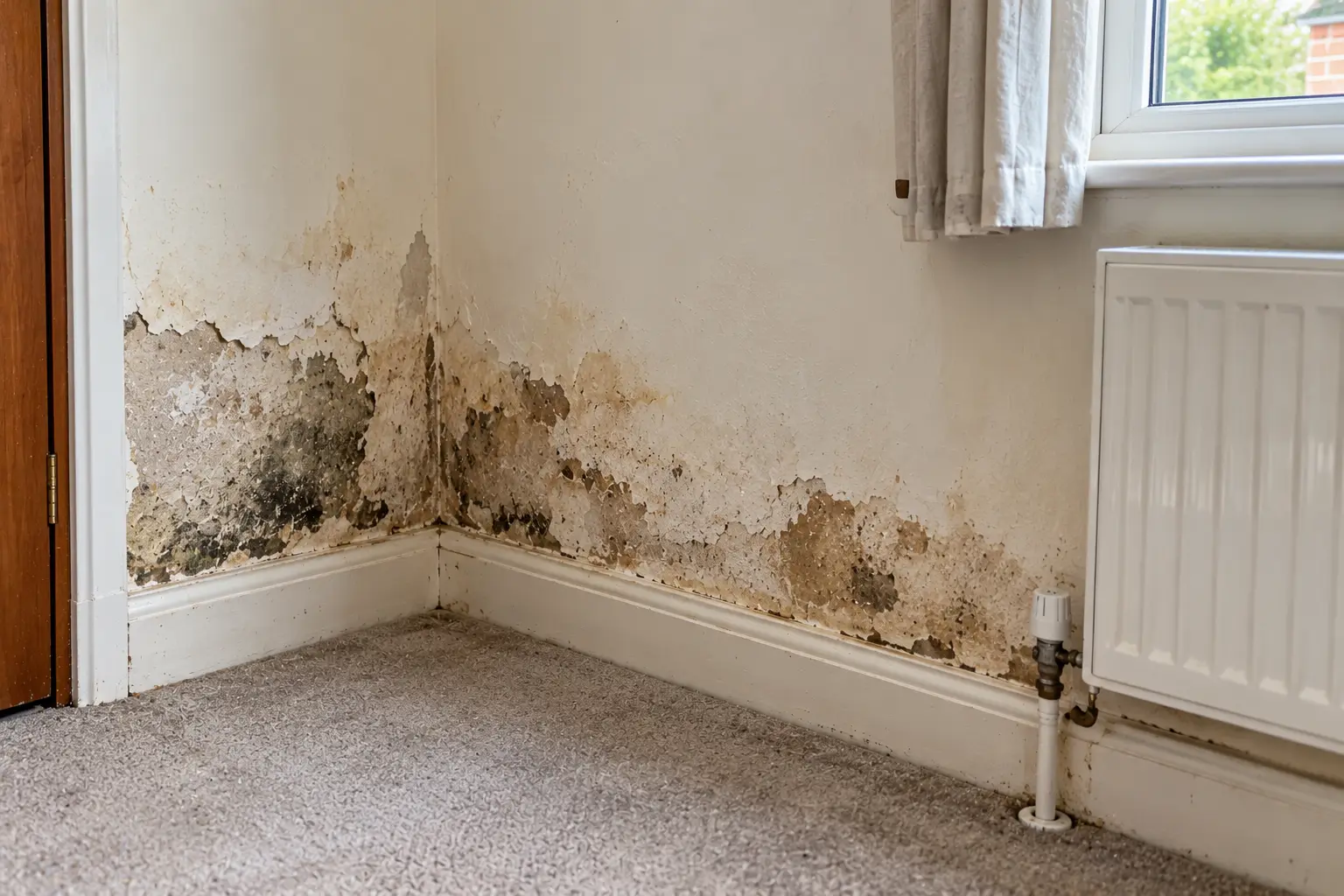
Why older Northwood walls can draw up moisture
Northwood’s Edwardian and Arts and Crafts houses around Frithwood, and interwar homes in Northwood Hills, have different wall and floor constructions. Older walls may have an original slate or bitumen damp proof course, known as a DPC. Gaps or deterioration can allow ground moisture to travel upwards through porous masonry.
A sound course can also be bridged. Raised beds, higher patios and render plinths can carry moisture past the barrier, while changes to solid floors can affect the wall-floor junction. Our Northwood area page provides local coverage information; this page focuses on rising damp.
- Soil or mulch piled against the outside wall.
- Paving raised above the original damp proof course.
- Render continuing across the course down to ground level.
Sloping gardens and moisture beside the house
Hilly, wooded parts of Northwood need particular care when assessing outside ground levels. Clay can retain rainwater beside foundations, and a garden that slopes towards a house can leave one elevation wetter than another. Shaded ground near Copse Wood or Park Wood may dry slowly.
These conditions do not prove rising damp, but they make the relationship between soil, paving and the DPC worth examining. Raised planting beds against a detached house can conceal that relationship. Removing a bridge may be more appropriate than immediately installing another course.
Diagnosis before a treatment decision
A rising damp assessment should compare moisture readings at different heights with visible damage, outside levels and the position of any existing DPC. One high meter reading alone is not enough: salts and the material being tested can affect results. Skirting, plaster and wall-floor junctions also need consideration.
The survey rules out penetrating damp, condensation and leaks before identifying rising damp. In larger Northwood homes, assessing each affected wall separately helps avoid assuming every mark has the same cause.
For warning signs to note before your appointment, read our guide to signs of rising damp. Photographs of changes over time can help explain what you have noticed.
DPC cream injection where a new barrier is needed
Where diagnosis supports a new chemical DPC, cream injection introduces a water-repellent barrier into a suitable mortar joint through drilled holes. The injection line needs to account for wall construction, ground levels and adjoining floors. A bridged course still needs its bridging addressed.
Damp Pro and Co uses a BBA approved damp proofing system, with PCA trained and Safeguard Ltd trained technicians. Our rising damp treatment information explains the service. Treatment decisions should follow the findings rather than the age or appearance of the house alone.
Salt-resistant replastering and drying
Ground moisture can leave salts behind in plaster as it evaporates. Even after a moisture barrier is established, contaminated finishes may remain unsuitable for decorating. Where needed, removing affected plaster and using a salt-resistant replastering specification forms part of the treatment.
Walls need time to dry; a new DPC does not instantly remove moisture already held in masonry. Thick walls in older Northwood houses can make drying less straightforward. Decoration should follow the requirements of the plaster system and the condition of the wall, rather than a fixed assumption about timing.
Arrange a Northwood rising damp survey
Run by Seth Long, Damp Pro and Co has over 30 years' experience. Completed damp proof course work comes with a 20-year guarantee certificate; this does not cover other work.
Call 07803 253337 or freephone 0800 593 0300 to arrange a free, no-obligation damp survey. We are open 24 hours, seven days a week. For the broader local service page, visit damp proofing in Northwood.
Northwood: common questions
Does an Edwardian Northwood house automatically need a new DPC?
No. Its original course may still function. Check its condition and possible bridging before deciding that replacement is necessary.
Could raised beds cause rising damp in my Northwood Hills home?
Beds above the DPC can bridge it. Compare soil levels with the course before choosing treatment.
Does Northwood’s clay ground prove my wall has rising damp?
No. Clay can hold moisture near walls, but diagnosis still requires evidence from the masonry, finishes and ground levels.
Will cream injection suit my Northwood home’s older walls?
Suitability depends on wall construction and condition. The survey should establish an appropriate injection position and identify any bridging.
Is replastering in my Northwood house covered by the 20-year guarantee?
No. The 20-year guarantee certificate applies only to completed DPC work, not replastering or other work.