
Canal-side growth and the wall-to-ground connection
J. Lyons & Co. opened its factory in 1921 on a 63-acre canal-side site and quickly became Greenford’s biggest employer. That history helps explain the town’s growth, but it does not tell us which damp course or floor construction an individual home has.
The Grand Union Canal crosses the town, with Horsenden Hill rising to 85 metres. For a property close to the canal, moisture exposure is a background consideration rather than proof of rising damp. Start with the wall base, the existing barrier and the relationship between outside ground and indoor floor levels. Our Greenford area page introduces the broader household services.
In the wider area, interwar suburban houses may have suspended timber floors and airbricks. Treat those features as possibilities to check, not as a description of every Greenford home. Where present, clear ventilation openings and an unbridged damp course matter; an old course may still be serviceable.
Different checks for a house and a ground-floor flat
Across the London Borough of Ealing, Census 2021 records 49.5% of homes as flats or other accommodation, 23.4% as terraced and 21.9% as semi-detached. These are authority-wide figures, not Greenford’s own housing proportions. In a ground-floor flat, establish which wall touches the ground and whether the floor junction has changed before interpreting low staining.
A raised patio, deep planting bed or render crossing the damp course can bridge an otherwise effective barrier. A later solid floor next to a suspended floor may also change the moisture route. For damp proofing in Greenford, correcting such a detail can be more important than automatically adding another course.
North Greenford, Greenford Green and Greenford Broadway are useful neighbourhood references when enquiring; give the full address as well. Greenford belongs to Ealing. South Greenford station is on the A40 in Perivale, not in the town centre, so the station name alone can be misleading when identifying a property.
Diagnosing rising damp rather than relying on a stain
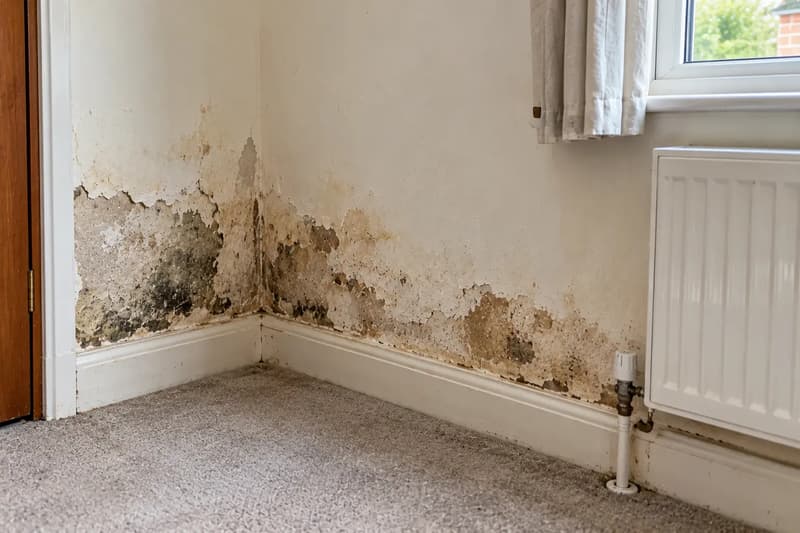
The survey looks at the height and pattern of damage, moisture readings at different positions, visible salts and the relationship between internal floors and outside ground levels. A single high meter reading is not proof of rising damp, because salts and different materials can affect readings. Findings need to be considered together before recommending treatment.
The survey also rules out condensation, penetrating damp and leaks before a rising-damp treatment is recommended. Tell us when the marks first appeared and whether paving, garden levels or floors have changed. Our guide to signs of rising damp explains what to notice, without treating every patch of damaged plaster as evidence that a DPC has failed.
DPC cream injection where a new barrier is needed
Where the assessment confirms that a new damp proof course is needed, DPC cream injection introduces a water-repellent barrier into a suitable mortar bed. Holes are drilled at the specified spacing and depth, then filled with the cream. Wall thickness, construction and the position of adjoining floors all influence how the course should be set out.
Damp Pro and Co uses a BBA approved damp proofing system, with PCA trained and Safeguard Ltd trained technicians and over 30 years' experience. Any bridging must also be addressed rather than simply covered over. Read about our rising damp treatment for the wider process, from establishing the cause to planning the work needed.
Salt-resistant replastering and allowing walls to dry
Rising moisture can carry ground salts into plaster, leaving deposits and damaged finishes even after the moisture route has been interrupted. Where plaster is contaminated, salt-resistant replastering helps protect the replacement finish from residual salts. Painting over the existing surface is not a substitute for dealing with unsuitable plaster or the cause of the damp.
The extent of plaster removal should follow the findings rather than a guess based only on the visible stain. A new DPC does not instantly dry the masonry, so drying and redecoration need realistic timing. Wall thickness, moisture levels and room conditions can all affect progress; an apparently dry surface does not necessarily mean the wall beneath is ready.
Arrange a Greenford survey and understand the guarantee
Our Ruislip base is at 8 Manor Road, HA4 7LB. Run by Seth Long, Damp Pro and Co works for homeowners across West London and South Bucks. Call 07803 253337 or freephone 0800 593 0300 to arrange a free, no-obligation damp survey; we are open 24 hours, seven days.
Completed damp proof course work comes with a 20-year guarantee certificate. That guarantee applies to the DPC work, not replastering or other work, so keep that distinction in mind when discussing the proposed treatment.
Greenford: common questions
Does the old J. Lyons canal-side site indicate a failed damp course nearby?
No. The factory’s history explains local growth, not the condition of a home’s masonry. The existing course, floors and moisture pattern need inspection.
What matters most for a ground-floor flat near Greenford Broadway?
Check whether the affected wall contacts the ground, how the floor meets it and whether outside levels bridge the damp course. Condensation and leaks can also mark lower walls.
Should airbricks be checked in an interwar house in the wider Greenford area?
Yes, where a suspended floor and airbricks are present. These are indicative construction features, not confirmed details of every home; obstructed openings need attention alongside the damp diagnosis.
Can a landlord use the borough’s rental figures as evidence of rising damp?
No. The 34.0% private-rented share across Ealing is Census context, not evidence about a wall. A documented diagnosis needs observations from the individual property.
Does DPC treatment include a guarantee for all plaster work?
Completed DPC work receives a 20-year guarantee certificate for the damp proof course itself. It does not extend to replastering or other work. Discuss salt-affected finishes separately when arranging the free homeowner survey.