
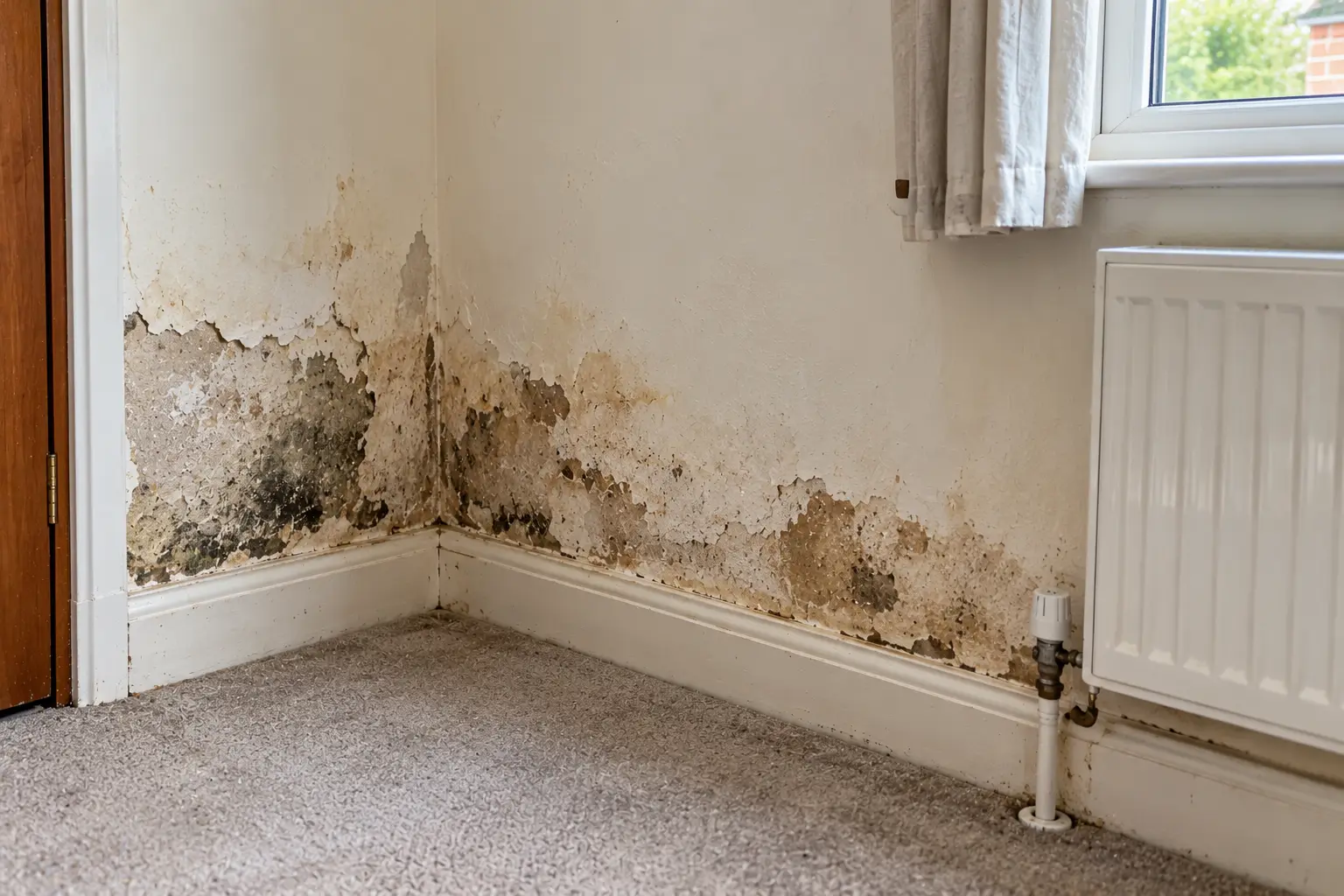
Greenford homes and the wider damp picture
Greenford’s 1930s semis and terraces sit alongside post-war homes and newer developments. Many older properties retain an original damp course and suspended timber floors, but their age alone does not establish the cause of a damp patch. Alterations, external maintenance and everyday moisture all need consideration.
The River Brent and the Paddington Arm of the Grand Union Canal are part of the local setting. Clay ground around the Brent floodplain can remain wet through winter, making ground levels and drainage worth considering. Living near water does not, by itself, mean a house has rising damp.
When rain gets through walls and junctions
On a typical Greenford semi, worn pointing, cracked render or a leaking gutter can allow rainwater to soak masonry. A faulty downpipe may repeatedly wet one narrow area, while gaps around a bay window can leave marks indoors. Patches that darken after rainfall are useful clues, although their position may not reveal the entry point.
Chimney details and flat roofs over extensions also deserve attention when staining appears upstairs or where an addition meets the original house. Our penetrating damp treatment service addresses this type of damp. The route water takes needs attention: covering a stain or decorating before the source is resolved is unlikely to give a lasting result.
Condensation in flats, conversions and busy homes
Cooking, showering and drying laundry indoors add moisture to the air. In flats and converted homes, that moisture can settle on cold windows, external corners and walls behind furniture. A busy household may notice the problem most in bedrooms overnight, even when there is no obvious leak through the building.
Condensation control means looking at moisture production, heating patterns and how air moves through the home. We offer condensation control and mould treatment, and may recommend ventilation improvements. Keeping existing vents clear, using available extraction and leaving space behind furniture can help, but persistent patches should still be assessed rather than automatically labelled condensation.
Separate low-level damp from other causes
Low marks on a wall, damaged skirting or powdery deposits can justify further investigation, but no single sign proves that a damp course has failed. Rainwater, raised external ground and indoor condensation can complicate the picture. The pattern, timing and surrounding building details matter more than a label based on appearance alone.
For the separate subject of moisture rising through masonry, see our rising damp treatment in Greenford page. It keeps that issue distinct from the rain penetration, condensation and mould covered here, so you can read the guidance most relevant to your home.
Arrange a free damp survey in UB6
A useful starting point is to note when the damp appears and what changes it: heavy rain, colder weather or everyday activities. If safe to do so, take photographs showing the patch and its surroundings. You do not need to remove plaster or decide on a treatment before arranging a free, no-obligation damp survey.
Damp Pro and Co is run by Seth Long, with PCA trained and Safeguard Ltd trained technicians and over 30 years' experience. We use a BBA approved damp proofing system. Completed damp proof course (DPC) work comes with a 20-year guarantee certificate; this does not apply to condensation control, mould treatment or other work.
Contact Damp Pro and Co from Greenford
Greenford, in the London Borough of Ealing, is about five miles south-east of our Ruislip base at 8 Manor Road, Ruislip HA4 7LB. We work for homeowners across West London and South Bucks. Our Greenford area page brings together the local service links.
Call 07803 253337 or freephone 0800 593 0300 to discuss the marks, moisture or mould you have noticed. We are open 24 hours, seven days a week. You can also contact us to request a free, no-obligation damp survey.
Greenford: common questions
Could a patch after rain be penetrating damp?
Yes, especially if it repeatedly darkens during wet weather. Gutters, pointing, render and roof junctions are possible sources, but water can travel before becoming visible indoors.
Does living near the River Brent mean my home will be damp?
No. Wet ground is relevant locally, but the condition of the building, drainage and indoor moisture also matter. Proximity to the river or canal is not a diagnosis.
Why does mould return behind bedroom furniture?
Cold walls and restricted air movement can encourage condensation behind wardrobes or beds. Cleaning alone may not prevent recurrence if moisture continues to collect on the same surface.
Can condensation and penetrating damp occur together?
Yes. A rain-soaked wall and moisture from everyday activities can affect the same room. Addressing only one source may leave visible damp or mould, so both possibilities deserve consideration.
Is the damp survey free for Greenford homeowners?
Yes, we offer a free, no-obligation damp survey in Greenford. Call 07803 253337 or 0800 593 0300 to arrange one.