

A Ruislip base serving West London
West London is the part of the capital north of the Thames and west of the City, out to the Greater London boundary, and historically much of it lay in Middlesex. It is not a single borough: Hillingdon, Ealing and Hounslow are each their own planning authority, covering places such as Ruislip, Uxbridge, Hayes, Greenford and Southall.
Damp Pro and Co is based at 8 Manor Road, Ruislip HA4 7LB and works for homeowners within roughly a 12-mile radius, across West London and South Bucks towards High Wycombe. If you are searching for a damp specialist in London, check the coverage before arranging a visit. Give us your address and describe the affected rooms when you call 07803 253337; you do not need to identify the cause yourself.
Housing across the three boroughs
Ruislip grew as a Metro-land suburb after its Metropolitan Railway station opened in 1904, and much of Ealing was rebuilt after the railway arrived as predominantly semi-detached housing. In Hounslow, the 1920s Great West Road brought factories and a great deal of new housing alongside them. The result is a mixture of late-Victorian and Edwardian homes, interwar semis and later flats, spanning solid-wall and early cavity construction.
Census 2021 figures, recorded at borough level, show how varied the housing is. In Hillingdon, 35.1% of homes were semi-detached and 30.9% were flats, with 25.9% privately rented. In Ealing, flats made up 49.5% of homes and 34.0% were privately rented; in Hounslow, 45.8% were flats and 30.9% privately rented. High flat shares and private renting mean many condensation and mould cases arise in flats, often with a landlord or managing agent involved in decisions about the building.
Ground, rivers and moisture routes
Much of the area sits on London Clay over chalk: an 1864 well on Ruislip High Street reportedly passed through about 90 feet of London Clay before reaching chalk. Clay holds moisture, so before rising damp is diagnosed it is worth checking outside ground levels, raised paths and drainage. Garden improvements can change conditions at the base of a wall, and raised paving or flower beds may bridge an existing damp proof course, letting moisture bypass it.
Watercourses shape local conditions too. The Colne, the Pinn and the Frays River meet around Uxbridge, the Brent runs through Ealing's Pitshanger Park, and the Crane follows Hounslow's western boundary, with Flood Zone 3 mapped along its corridor. The Grand Union Canal passes through Uxbridge, Hayes and Greenford. Low-lying streets along the Crane and Colne corridors can see flood-related damp, which needs a different response from an injected damp proof course.
Distinguishing the source before treating it
Rising damp is moisture moving upwards through porous masonry from the ground. Low-level staining and salt deposits can be clues, although neither confirms the cause on its own. Where assessment supports that diagnosis, rising damp treatment addresses the upward moisture route rather than simply covering damaged plaster.
Penetrating damp enters through the building fabric, often at defective pointing, gutters or openings, and its appearance may change after rainfall. Condensation forms when moist indoor air meets a cold surface; windows, corners and areas behind furniture can be affected. Mould needs its moisture conditions addressed alongside treatment of the affected surface. Read rising damp versus condensation if you are comparing those signs. More than one source can be present in a home.
Conservation areas and water hardness
Hillingdon has 31 conservation areas, including Ruislip Village, Ruislip Manor Way, Eastcote Village and the Eastcote Park Estate. Ealing's include Ealing Green, Haven Green and the Brentham Garden Estate, and Hounslow's include Heston Village and Spring Grove. On visible elevations in these areas, breathable, sympathetic treatments are preferred, so the specification should respect the building rather than simply sealing it.
Water hardness varies by supplier. Affinity Water serves much of the north-west, with Greenford recorded at 304 mg/l, classed as very hard, and Northwood at 348 mg/l, while Hounslow is supplied by Thames Water; London water is generally hard. Hard water does not cause damp, but it is part of the local picture when condensation and ventilation are discussed.
What the free survey checks
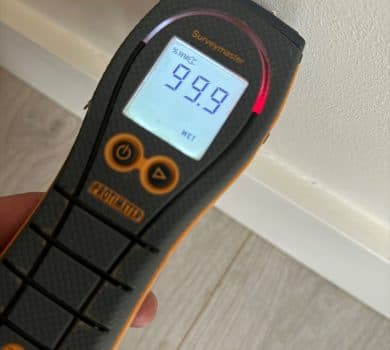
A free damp survey brings the visible symptoms and the building details together. During the survey, we inspect inside and outside, taking moisture readings and checking external ground levels, rainwater fittings, pointing, airbricks and ventilation. Readings help map moisture but need interpreting alongside wall materials and the pattern of damage; one high reading is not a diagnosis.
Before the visit, note whether the patch changes after wet weather or household activities. Photographs taken on different dates can be useful, particularly if the wall looks dry when someone arrives. Keep the affected area visible and accessible where practical, without dismantling fittings or climbing to inspect gutters. Explain any changes to paving, heating or room use that might help put the symptoms in context.
Treatment matched to the wall
Our technicians are PCA trained and Safeguard-trained, and Damp Pro and Co uses a BBA-approved treatment system. For confirmed rising damp in suitable masonry, an injected DPC creates a water-repellent barrier within the mortar course. The survey should come before deciding where that treatment belongs or whether injection is needed at all.
A new DPC does not repair a rainwater defect, remove residual salts or change indoor humidity. Those issues need their own consideration. Ask which preparation and plaster repairs are proposed, and how any external bridging will be addressed. Understanding the complete approach matters more than choosing a single product because its name sounds familiar.
The DPC guarantee certificate
Damp Pro and Co issues a 20-year guarantee certificate on completion of damp proof course work and payment. The certificate relates to the damp proof course work itself. Keep the certificate with the treatment records and ask about its scope before agreeing to work.
Our damp proof course guarantee guide explains what homeowners should ask about a certificate. If you have questions about what the certificate covers, ask us during the survey.
Find your local coverage page
Existing local pages cover Ealing, Harrow, Wembley and Southall. You can also read about Hayes, Greenford, Northolt and our base in Ruislip. These pages explain local housing and the damp issues worth checking in your home.
For damp proofing enquiries in London outside that coverage, call to check your address. To arrange help for your home, use the contact page or call 07803 253337. Tell us your postcode and what you have noticed; we will arrange a survey time that suits you.
Towards Brent, Hendon and Edgware, see our north London damp proofing guide and ask Seth to confirm coverage for your address.
Common questions
Do you cover central London?
We focus on West London and South Bucks within about 12 miles of Ruislip. Call 07803 253337 with your address and we will tell you whether we can help.
Why does the housing mix matter for damp in West London?
Borough-level Census 2021 figures show flats make up nearly half of homes in Ealing and Hounslow, while Hillingdon has more semi-detached houses. Flats often involve shared walls and landlord responsibilities, while semis more often raise questions about ground levels, bays and original damp proof courses.
Is the survey really free?
Yes. Damp Pro and Co offers free damp surveys for homeowners. Request a visit through our free damp survey page.
What if it turns out to be condensation, not rising damp?
The response should address condensation conditions rather than installing a DPC for the wrong cause. Damp Pro and Co treats condensation and mould as well as rising and penetrating damp.
Do I need to replaster after treatment?
It depends on plaster condition, salts and the specified treatment. Read our replastering after damp proofing guide and ask which finishes need attention during the survey.