
Why Denham's older walls need careful assessment
Around Denham village and St Mary's Church, older brick cottages sit alongside timber-framed buildings with masonry sections. Some walls may have no original damp proof course, while later properties can have slate or bitumen barriers. Gaps, deterioration or alterations can leave a route for moisture to rise through porous masonry.
Denham Green and Higher Denham also have larger detached homes, with interwar housing near the station. Age alone does not establish rising damp: later changes to floors and outside levels matter too. Our Denham area page provides local coverage information; this page focuses on moisture rising from the ground.
Valley ground and bridges around an existing DPC
The Misbourne and River Colne pass through Denham's low-lying valley landscape. Ground near the rivers and Denham Country Park can stay wet, and some homes face a high water table. That increases the importance of a working moisture barrier, but proximity to water is not proof that a wall has rising damp.
Patios, raised beds and soil banked against brickwork can bridge an otherwise serviceable DPC. A render plinth extending across the barrier can create another route, while replacement solid floors may affect moisture movement at wall edges. Removing a bridge may be more appropriate than immediately adding a new course, depending on the findings.
Checking the cause before recommending treatment
Diagnosis brings together moisture readings at different heights, the pattern of damage and checks of accessible wall bases, floor junctions and external levels. A high meter reading alone is not enough, because salts and different materials can affect readings. The survey also rules out condensation, penetrating damp and plumbing leaks before recommending rising damp treatment.
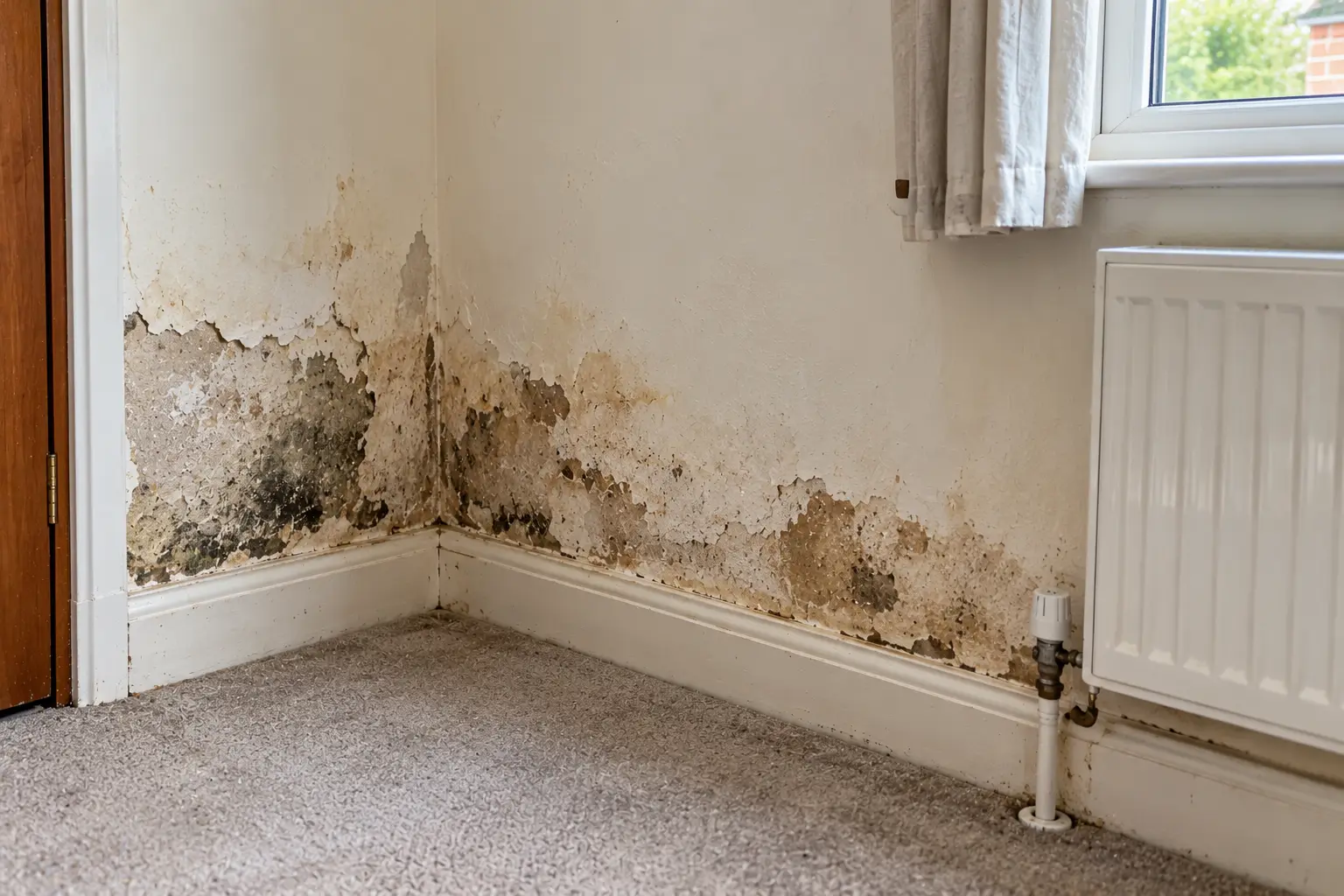
A tide-like mark, powdery deposits and plaster breaking down near skirting level are useful clues, not a diagnosis by themselves. We assess these signs against the building's construction and any visible DPC. Our guide to signs of rising damp explains what to note before the survey, including the height and spread of damage.
DPC cream injection suited to the masonry
Where a new chemical DPC is appropriate, cream is injected into a series of drilled holes along a suitable mortar bed. It spreads into the masonry to form a barrier against upward moisture movement. The position needs to account for outside ground levels and the internal floor, rather than following a convenient line.
Wall thickness, condition and construction influence the treatment arrangement, particularly in older cottages with mixed masonry. Timber-framed buildings need careful assessment of the masonry involved; injection is not a treatment for the frame. Damp Pro and Co uses a BBA approved damp proofing system, with further information on our rising damp treatment service.
Salt-resistant replastering and the drying period
Stopping the upward supply of moisture does not remove salts already carried into plaster. Contaminated plaster can continue to attract moisture from the air, leaving a patch that looks damp even after DPC treatment. Where necessary, affected plaster is removed and replaced with a suitable salt-resistant specification rather than simply covered over.
The extent of replastering should follow the contamination and condition of the wall, not just the visible stain. Drying takes time and varies with wall thickness, materials and conditions inside the home. Decoration should wait until the surface is ready; an injected DPC does not make saturated masonry dry overnight.
Arrange a rising damp survey in Denham
Run by Seth Long from Ruislip, Damp Pro and Co serves Denham homeowners around four miles west of its base. The business has over 30 years' experience, with PCA trained and Safeguard Ltd trained technicians. Completed damp proof course work comes with a 20-year guarantee certificate; this does not cover other work.
Call 07803 253337 or freephone 0800 593 0300 to arrange a free, no-obligation damp survey. We are open 24 hours, seven days a week. For the broader local service overview, visit our damp proofing in Denham page.
Denham: common questions
Does living near the Misbourne mean my Denham home needs a new DPC?
No. Wet valley ground can increase moisture exposure, but a functioning, unbridged DPC may still protect the wall. The survey needs to establish an upward moisture path.
Can a Denham village cottage with slate DPCs still get rising damp?
Yes, if the slate barrier is interrupted or bridged. Its presence is worth checking before deciding that injection is needed.
Could a raised patio cause rising damp in my Denham Green home?
A patio above the DPC can allow moisture to bypass it. Correcting that bridge may be necessary even if a new chemical course is proposed.
Will my Higher Denham home need replastering after injection?
That depends on plaster damage and salt contamination. Sound, uncontaminated plaster is different from plaster that remains moisture-attracting because of salts.
What guarantee applies to DPC work at my Denham property?
Completed DPC work receives a 20-year guarantee certificate. This guarantee applies to the damp proof course work only, not replastering or other work.