
Rivers, locks and wetter ground
The canal passes the village, and the Denham Lock conservation area lies on the Hillingdon side. Along the River Colne, the Environment Agency maps Flood Zones 2 and 3. Properties closer to the river and canal can face more groundwater, which is a reason to look carefully, not a finding.
When you book, say if you are near the locks or the Colne, and whether your lawn or any shed or garage floor stays wet after rain. That shapes the order of checks, yet it never on its own shows that a damp course has stopped working.
Low-level damp is explained on rising damp treatment in Denham; broader problems on damp proofing in Denham.
Old village houses that need to breathe
The village's older homes were built to let moisture in and out. Fixing the source of water and using breathable materials normally comes first; cement render or sealing coatings on these walls can hold dampness inside. See penetrating damp treatment.
Before we come, have a look for later additions: a patch of hard render, modern masonry paint, silicone sealant around frames. If moisture is trapped behind one of these, the first job is usually taking it off so the wall can dry, rather than adding yet another layer.
Denham Garden Village
In the Garden Village, subfloor ventilation and airbricks need checking alongside condensation. Mould on cold external walls is usually down to moisture and airflow, so see condensation control.
Walk the outside first and make sure the airbricks are not buried under soil or hidden by shrubs. Indoors, notice whether a musty smell lingers near the floor and whether mould sticks to the coldest outside walls. The first points below the floor; the second points to the air in the room.
Telling the causes apart
Because Denham's setting is wet, it is tempting to blame the ground for everything. In reality three quite different things show up: water from the soil reaching the wall base, rain getting through older masonry, and condensation from daily living. Each leaves a different signature.
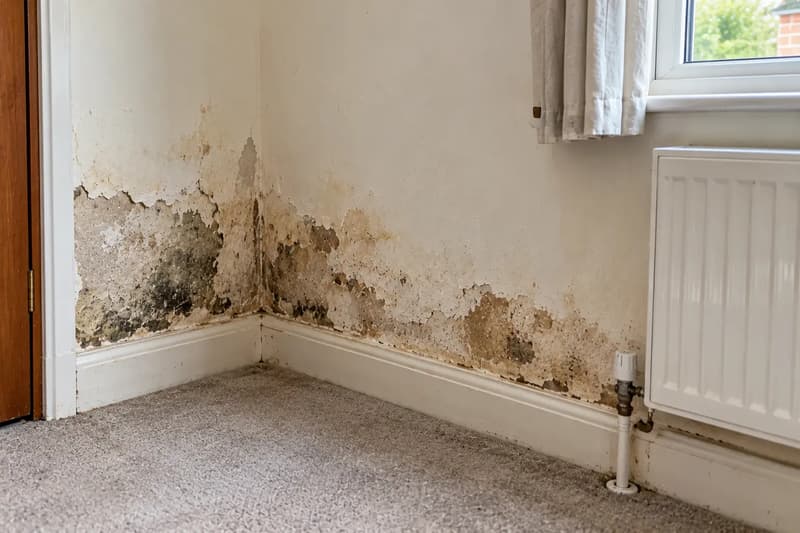
Ground moisture tends to sit in a band near the floor and may leave salts behind. Rain penetration follows the weather and often lines up with a gutter, a cracked sill or tired pointing. Condensation favours cold corners, window reveals and the backs of wardrobes, and it gets worse in winter. Noting which description fits saves time.
Buckinghamshire context
Countywide, Census 2021 shows 70.0% of Buckinghamshire households owning their homes and 34.3% of dwellings detached. The figures cover the county rather than Denham. Affinity Water supplies the village with hard water, so scale on taps is expected and has no connection with damp.
Survey from just over the border
Damp Pro and Co works from 8 Manor Road, Ruislip HA4 7LB, a short drive across the county line, and is run by Seth Long, whose experience exceeds 30 years. The technicians trained with the PCA and Safeguard Ltd.
Damp proof courses use a BBA approved system, and when one is completed a 20-year guarantee certificate is issued for that DPC alone. Call 07803 253337 or freephone 0800 593 0300, open 24 hours on all seven days, or arrange your free survey.
Denham: common questions
Is a home near Denham Lock likely to be damp?
Not necessarily. The wetter setting just means groundwater gets checked carefully.
Can you treat an older village house?
Yes, with breathable materials suited to traditional walls.
What do you check in a Garden Village home?
Airbricks, subfloor ventilation and signs of condensation.
Is Denham in London?
No, it lies in Buckinghamshire.
Are the Census figures for Denham?
No, they describe Buckinghamshire as a whole.