
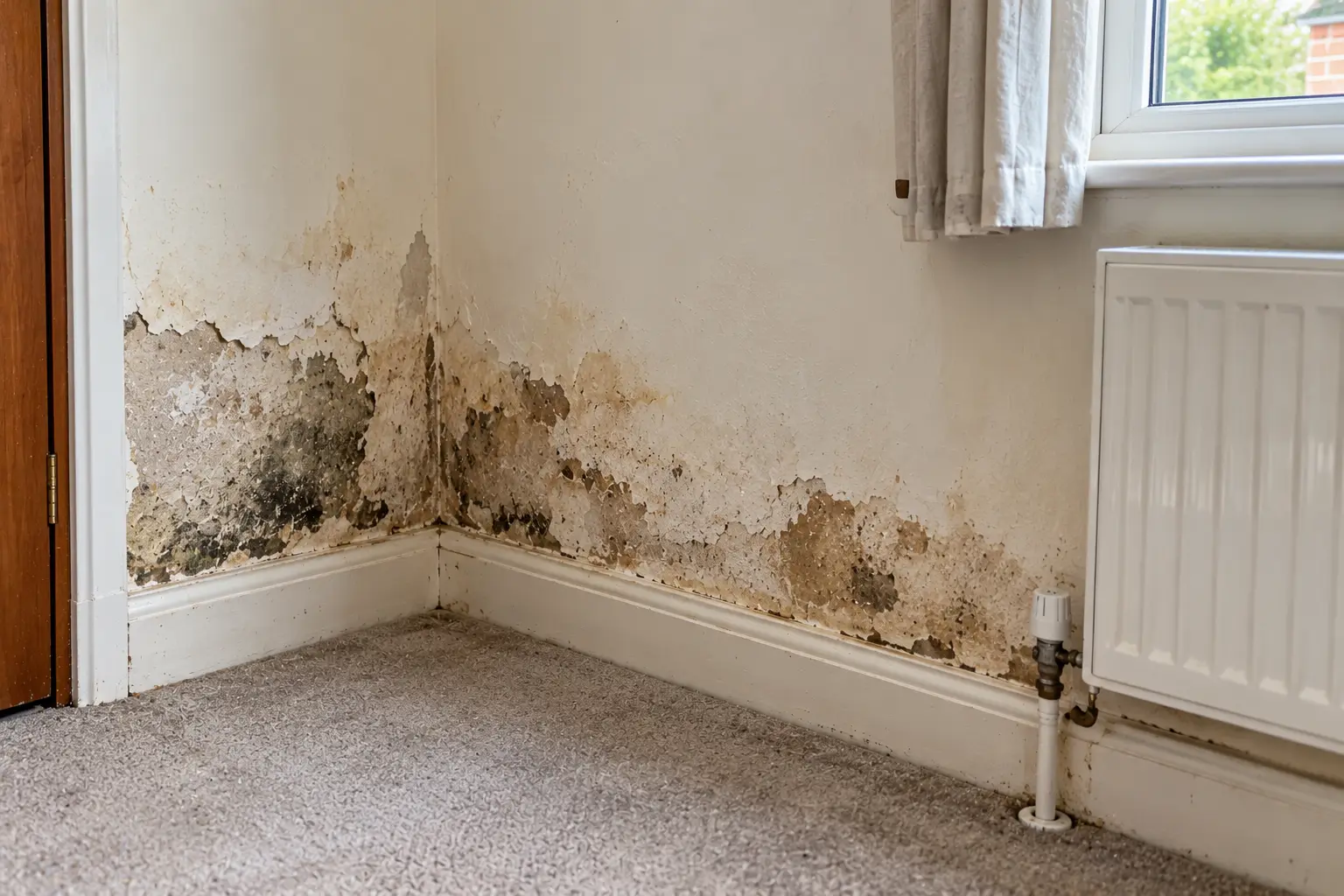
Why older Southall walls need a careful check
Victorian and Edwardian terraces around Southall Broadway and King Street may retain original slate or bitumen damp proof courses. These barriers can be damaged or bridged over time, allowing ground moisture to travel into absorbent masonry. Age alone, however, does not prove that a new course is needed.
Interwar homes towards Dormers Wells and Norwood Green can have similar problems where later alterations change ground levels. Southall’s flat setting near the Grand Union Canal and Brent valley makes ground conditions worth considering, but proximity to water is not a diagnosis. Our Southall area page gives local service information.
Patios, extensions and hidden bridges
A raised patio or flower bed can carry damp above an otherwise effective damp proof course. Render plinths extending below the barrier can also provide a route around it. Look for changes in external levels beside the affected wall rather than assuming the barrier itself has failed.
Large rear extensions and replacement solid floors deserve attention too. The junction between the floor’s moisture barrier and the wall DPC may be interrupted or bridged. In Southall terraces with several generations of alterations, identifying those junctions helps distinguish a local bridge from a problem requiring rising damp treatment.
Diagnosing rising damp before specifying work
Diagnosis brings together moisture readings at different heights, the pattern of plaster damage and checks on the existing DPC and surrounding ground levels. A single high meter reading is not enough: salts can affect readings, so results need interpreting alongside the condition of the wall.
The survey also rules out condensation, penetrating damp and plumbing leaks before rising damp treatment is recommended. White crystalline deposits and a low tide mark can support the assessment, but neither is conclusive by itself. Our guide to salt on walls explains why deposits need careful interpretation.
DPC cream injection where it is needed
Where a replacement chemical DPC is appropriate, cream is injected into drilled holes along a suitable mortar bed. It forms a barrier against moisture rising through the masonry. Wall thickness, construction and continuity around adjoining walls matter when deciding the treatment line.
Damp Pro and Co uses a BBA approved damp proofing system. Bridging still needs addressing: an injected course should not be treated as a substitute for correcting a patio or render detail that bypasses it. You can find broader service information on our damp proofing in Southall page.
Salt-resistant replastering and drying
Stopping the upward movement of water does not remove salts already carried into plaster. Contaminated material may need removing and replacing with a salt-resistant replastering specification. Simply covering damaged plaster with a fresh skim can leave the underlying salt problem unresolved.
Walls also need time to dry after treatment, with the rate depending on thickness, moisture levels and finishes. Decoration should follow the treatment and plastering guidance rather than a fixed assumption about drying time. The 20-year guarantee certificate applies to completed damp proof course work, not replastering or other work.
Arrange a Southall rising damp survey
Run by Seth Long, Damp Pro and Co has over 30 years' experience and PCA trained and Safeguard Ltd trained technicians. Our base is 8 Manor Road, Ruislip HA4 7LB, serving homeowners in West London and South Bucks.
Call 07803 253337 or freephone 0800 593 0300 to arrange a free, no-obligation damp survey. We are open 24 hours, seven days a week. Mention which walls are affected and any recent changes to paving or floor levels.
Southall: common questions
Does my Victorian Southall terrace automatically need a new DPC?
No. An original slate course may still work; checking for bridging and assessing the moisture pattern comes before recommending replacement.
Could a raised patio cause rising damp in my Norwood Green home?
Yes, if it bridges the DPC. The survey checks the patio level against the barrier and affected internal wall.
Does living near Southall locks prove that wall staining is rising damp?
No. Local ground moisture is relevant, but the wall construction, existing barrier and moisture readings must support the diagnosis.
Will DPC injection fix salty plaster in my Dormers Wells semi?
Injection does not remove existing salts. Salt-contaminated plaster may need replacement as part of the treatment specification.
What guarantee applies to DPC work at my Southall house?
Completed damp proof course work comes with a 20-year guarantee certificate. That guarantee does not cover replastering or other work.