
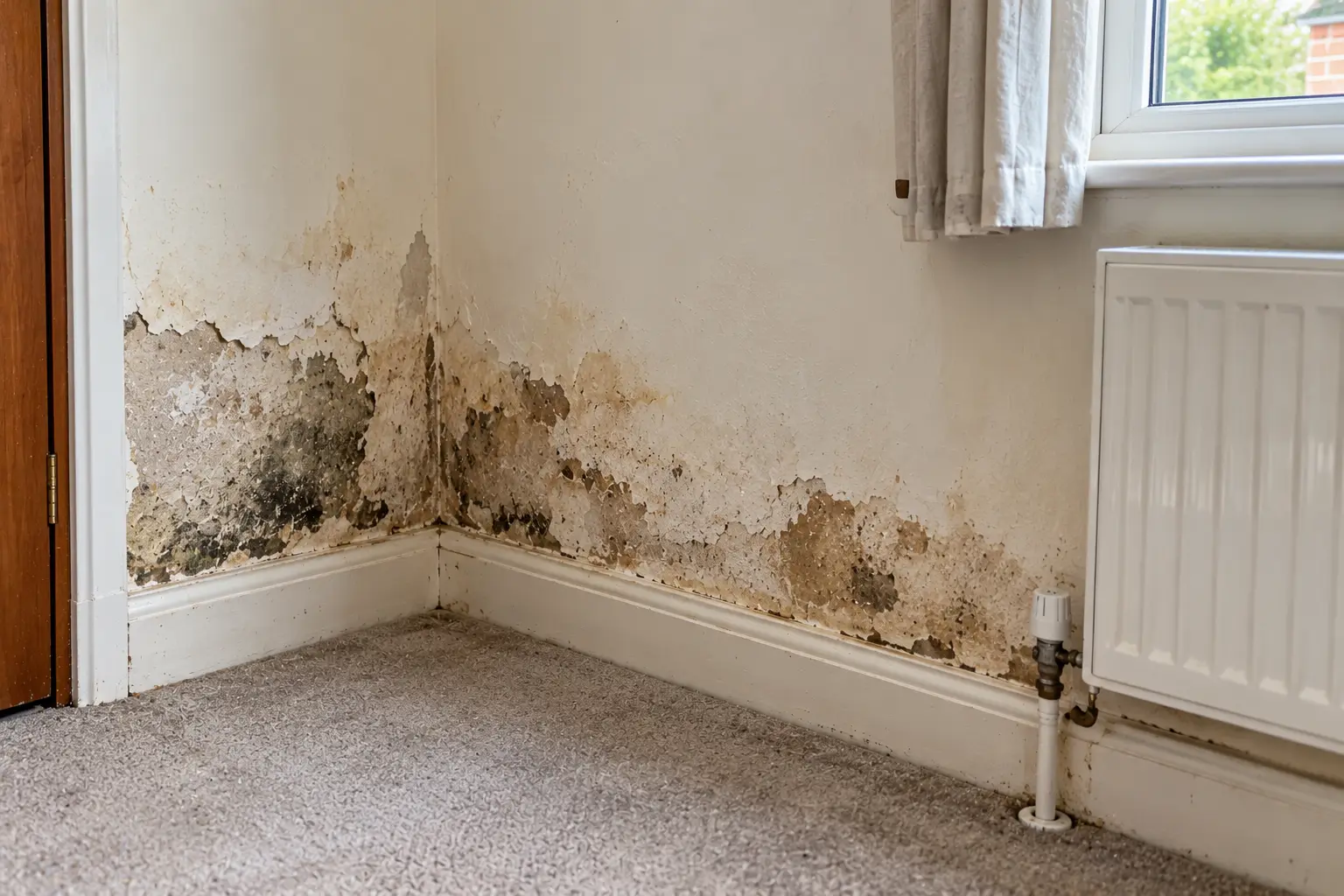
Why Wembley's older walls can become damp
Much of Wembley’s housing dates from the interwar years, including 1920s–30s terraces and the semis around Sudbury, Preston and North Wembley. Older Edwardian terraces near Wembley Central add a different wall construction to the mix. Original slate or bitumen damp proof courses may be damaged or bridged, allowing ground moisture to rise through porous masonry.
Heavy London Clay drains slowly, so the ground beside a wall can stay wet after rain. Around Alperton, near the Grand Union Canal and River Brent, ground levels and drainage deserve attention. Wet ground alone does not prove rising damp: the condition of the wall and its damp proof course matters too.
Extensions, patios and render can bridge a DPC
Extensions and alterations can change how an older Wembley home handles ground moisture. A patio laid too high, a raised bed against brickwork or a render plinth carried below the damp proof course can create a bridge around it. The original barrier may still be present, yet moisture has a route past it.
Solid floors also need checking where they meet older walls, particularly at the junction between a house and its extension. Different floor heights can hide a bridge or an awkward connection between moisture barriers. Removing an identifiable bridge may be necessary; injecting another course without addressing it may leave the underlying route for moisture in place.
Checking the evidence before recommending treatment
A rising damp assessment brings together moisture readings at different heights, the pattern of visible damage and the relationship between internal floors and outside ground levels. A high reading by itself is not a diagnosis, as salts and different materials can affect readings. The survey rules out condensation, penetrating damp and leaks before recommending rising damp treatment.
Inside, useful clues include deteriorating skirting, a low tide mark and powdery deposits left as moisture evaporates. Outside, the DPC position and any covering render or raised paving help explain what is happening. Our guide to signs of rising damp explains what to look for, without treating any single sign as proof.
DPC cream injection for affected walls
Where a chemical damp proof course is appropriate, DPC cream is injected into a series of holes drilled along a suitable mortar bed. It forms a water-repellent barrier intended to restrict moisture moving upwards through the masonry. Wall thickness, construction and the condition of the mortar influence the treatment layout.
Damp Pro and Co uses a BBA approved damp proofing system, with PCA trained and Safeguard Ltd trained technicians and over 30 years’ experience. Treatment should follow the findings rather than simply follow a visible stain. Read more about rising damp treatment, including why a new barrier must be considered alongside any bridging.
Salt-resistant replastering and drying
Ground moisture can carry dissolved salts into a wall, leaving them behind in the plaster as it dries. Some salts attract moisture from the air, so damaged plaster can remain troublesome after the upward moisture route has been addressed. Painting over the surface does not remove those deposits or repair weakened plaster.
Salt-resistant replastering involves removing affected material as needed and using a suitable plaster specification for the treated wall. Masonry still needs time to dry; cream injection does not dry it instantly. Decoration should follow the drying and finishing guidance for the materials used, rather than a fixed date assumed to suit every Wembley home.
Arrange a Wembley survey and check the guarantee
Completed damp proof course work comes with a 20-year guarantee certificate; this applies to DPC work, not other work. Keep the certificate with your property records and check its scope. For local coverage, see our Wembley area page or the separate damp proofing in Wembley page.
Run by Seth Long, Damp Pro and Co is based at 8 Manor Road, Ruislip HA4 7LB. Call 07803 253337 or freephone 0800 593 0300 to arrange a free, no-obligation damp survey. We are open 24 hours, seven days a week.
Wembley: common questions
Does my 1930s Sudbury semi automatically need a new DPC?
No. Age alone does not establish failure. The existing course, external levels and moisture pattern need checking before deciding whether injection is appropriate.
Could a raised patio cause rising damp in my North Wembley home?
It can bridge the damp proof course if laid too high. Checking its level against the DPC helps establish whether lowering it is needed.
Does living near the canal in Alperton prove rising damp?
No. Location is background information, not a diagnosis. The wall construction, ground levels, moisture readings and visible damage need to be assessed together.
Can render hide a bridged DPC on a Wembley terrace?
Yes. Render extending across the course can conceal its position and provide a moisture route. Its lower edge needs checking during the assessment.
Is replastering in my Wembley extension covered by the 20-year guarantee?
No. The 20-year guarantee certificate applies to completed DPC work only, not replastering or other work. Check the certificate for the scope of the covered work.