
Written by Seth Long, Damp Pro and Co · Last updated: 7 October 2026
How render protects a wall
Render is a coat of mortar applied to the outside of a wall. On many homes it was added for looks, on others to protect soft or uneven brickwork from the weather. A sound coat throws most rain off the face of the building and lets the small amount of moisture that does soak in dry back out between showers.
It only works while it stays in one piece and well bonded. Details matter too: a bell-mould or drip at the bottom edge, sills that project beyond the face, and neat junctions with windows and doors all help keep water running away from the wall rather than behind the render.
How cracks and hollow areas let water in
Fine cracks open as render shrinks, as the building moves or as the background expands and contracts with the seasons. Each crack acts like a small gutter, drawing rain in by capillary action. Once water is behind the render it struggles to get out again, because the coat that was meant to keep it out now holds it in.
Over time, that trapped moisture weakens the bond and the render becomes hollow. Hollow areas collect more water, freeze in cold spells and eventually bulge or fall away. Cracks around windows, at corners and where render meets a different material are common weak points.
Signs inside the house
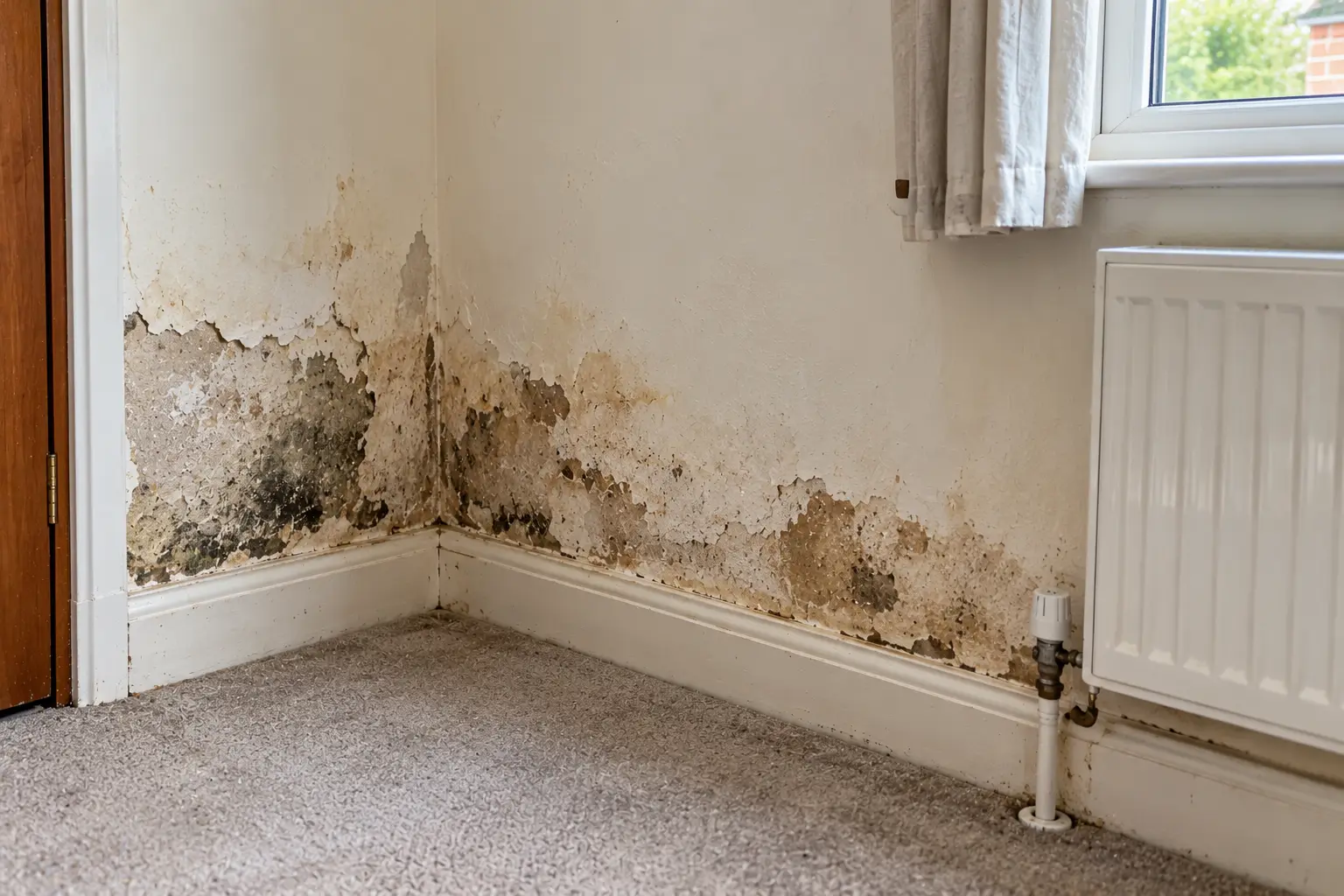
Penetrating damp through a rendered wall usually shows as patches that darken after wind-driven rain and fade in dry spells. They may sit at any height and often appear on the wall that faces the worst weather. You might see brown staining, paint lifting, or a cold, damp feel to the wall behind furniture.
Patches that line up with a crack or a hollow area outside are a strong clue. Our guide to wet patches on walls explains how the position and timing of a patch help separate rain getting in from other causes, and our types of damp guide sets the main kinds side by side.
Sand and cement render on older solid walls
Many older houses were built with soft bricks and lime mortar that let moisture move in and out freely. When they were later covered in a hard sand and cement render, that balance changed. The dense coat cracks rather than flexing, lets water in through the cracks, and then slows down drying from the wall behind it.
The result can be a solid wall that stays wetter for longer than it would have done bare, with damp showing inside and the brickwork behind gradually deteriorating. On these buildings, any repair needs to suit the original construction rather than simply adding another hard coat.
Render taken down past the DPC
Render that runs all the way to the ground creates a second problem. It forms a continuous path from wet soil or paving, over the damp proof course and up into the wall above. Even a sound course can be bypassed this way, and the damp that results looks very like rising damp.
The usual fix is to cut the render back so it stops above the course, finished with a bead or bell-mould so water drips clear. Our guide to the bridged damp proof course covers this and the other common ways a DPC is bypassed.
Repair versus re-render: what is assessed
Whether a wall needs local repairs or a larger section of render replaced depends on how much of it is hollow, how widely it has cracked, what the wall behind is made of and how wet the masonry has become. Tapping the render to map hollow areas and taking moisture readings inside both feed into that decision.
Isolated cracks in otherwise sound render can sometimes be cut out and filled. Widespread cracking, large hollow areas or render that bridges the damp proof course point towards a more extensive repair. Gutters, downpipes, sills and window seals are checked at the same time, as they often add to the water reaching the wall.
How we treat penetrating damp
Our approach to penetrating damp treatment is to inspect inside and out, take moisture readings and check gutters, pointing, render and openings to find where water is getting in. We then carry out repairs such as repointing, render repairs, resealing or water-repellent treatments, and once the wall is protected, damaged plaster inside is replaced.
Damp Pro and Co is based in Ruislip and covers West London and South Bucks. Call Seth on 07803 253337 or freephone 0800 593 0300 to talk about cracked render on your home.
Questions about this topic
Can hairline cracks in render let water in?
Yes. Even fine cracks can draw rain in, and once behind the render it dries out slowly.
Should render go down to the ground?
No. It should stop above the damp proof course, usually with a bead or bell-mould, so it does not bridge the course.
Is sand and cement render bad for old houses?
It can be on soft brick and lime-mortar walls, because it cracks and slows drying. Repairs should suit the original construction.
Can render be repaired rather than replaced?
Often, where cracks are isolated and the render is well bonded. Widespread hollow areas usually need a larger repair.
How do I know if render is hollow?
Tap it gently. Sound render gives a solid note; hollow areas sound drummy and may bulge or crack around the edges.
Related guides
- Wet patches on walls
Reading a wet patch by height, shape and timing to tell rising damp, rain getting in and leaks apart.
- Bridged damp proof course
How patios, flower beds, render and cavity debris let moisture bypass a DPC, and why the bridge is fixed first.
- Spalling bricks
Why brick faces flake away: saturation, frost, hard cement pointing and leaking gutters.