
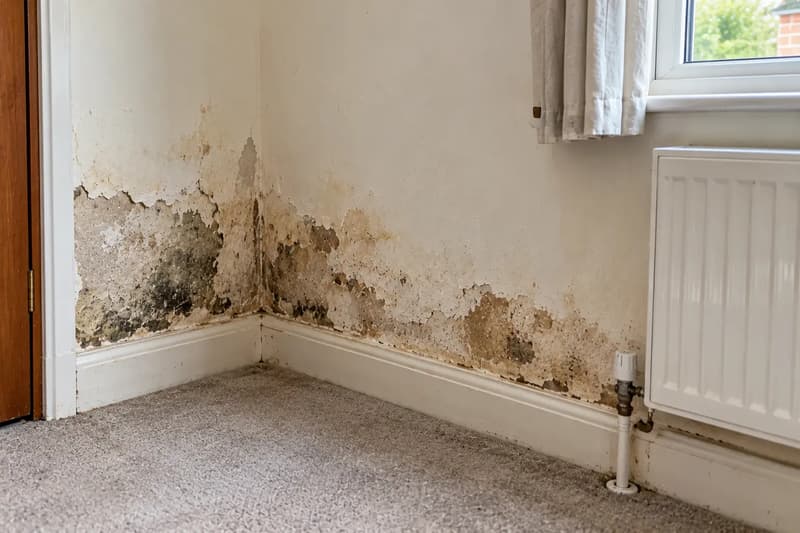
Period buildings on the Hill
Several conservation areas cover the Hill, among them Harrow on the Hill Village, Harrow School, Harrow Park, Roxborough Park and The Grove, Sudbury Hill, Mount Park Estate, Roxeth Hill and South Hill Avenue. Georgian and Victorian buildings there were generally built to breathe, so moisture must be able to leave the wall.
For such a building, a chemical damp proof course is not assumed. Rainwater goods, pointing, ground levels and breathable finishes are often dealt with first. Listed or conservation-area work may need Harrow Council's consent.
Exposure matters on the Hill. Walls facing the weather take more rain, and damp that appears on those sides after storms usually has an outside route.
Interwar semis further down
Borough-wide, Census 2021 records 37.1% of Harrow's homes as semi-detached, 16.9% terraced, 11.3% detached and 34.5% flats. Many local semis date from the 1920s and 1930s, often with suspended timber ground floors.
Here the survey normally covers airbricks, underfloor ventilation, any visible timbers and the wall base. For low-level damp, read rising damp treatment in Harrow.
Before we come, check the airbricks and note any paving laid against the walls since the house was built.
Flats near Station Road
Census 2021 shows 29.6% of the borough's households renting privately, 10.4% in social housing and 58.8% owning. Near Station Road and the St Anns and St George's centres, flats over shops and conversions are common.
In flats, mould on outside walls and windows usually comes from daily moisture meeting cold surfaces. Condensation control and landlord damp and mould explain the approach.
Extensions, HMOs and consent
Harrow Council handles planning, and its Article 4 directions cover residential extensions, HMOs and commercial-to-residential change. If damp work is part of a larger extension or conversion, check what permission is needed first.
Affinity Water supplies the town and describes its water as hard. Limescale on taps and screens is not a damp problem.
One borough, three kinds of job
Most Harrow enquiries fall into three groups: breathable repairs for period fabric on the Hill, floor and damp course checks in interwar semis, and condensation in flats. Telling us which applies lets us plan the visit.
Book your Harrow survey
Damp Pro and Co, Seth Long's company, operates from 8 Manor Road, Ruislip HA4 7LB, and covers homes throughout Harrow with more than 30 years of experience. The PCA and Safeguard Ltd trained its technicians.
Damp proof courses use a BBA approved system, and each completed one is issued with a 20-year guarantee certificate for that DPC only. Call 07803 253337 or freephone 0800 593 0300, open 24 hours every day, or request a free survey.
See our main Harrow damp specialists page.
Harrow: common questions
Will you inject a damp course into a period house on the Hill?
Not by default. Conservation-area buildings often need breathable, heritage-suited remedies, so the cause is found first.
What do you check in a 1930s Harrow semi?
Airbricks, underfloor ventilation, visible timbers, ground levels and the wall base, plus any rain routes.
Does an Article 4 direction affect damp proofing?
Rarely on its own, but extensions, HMOs and some changes of use are covered. Ask Harrow Council if the work is part of a bigger project.
Is Harrow's water hard?
Yes, according to supplier Affinity Water.
Are the Census figures for Harrow town only?
No, they describe the whole borough.