
Written by Seth Long, Damp Pro and Co · Last updated: 21 November 2026
Need this sorted?
Need help with penetrating damp treatment? Get a quote from Damp Pro and Co.
Why chimney breasts are prone to damp
Above the roofline, a stack is exposed on every side. It catches wind-driven rain more than most walls, has a sloping mortar or concrete cap called flaunching around the pots, and relies on lead flashing where it meets the tiles. Each of those details weathers over time, and any gap lets water into brickwork that runs straight down through the house.
Inside, the flue spent years carrying smoke from coal, wood or gas. Burning fuel leaves salts and tarry residue in the brickwork and render lining the flue. Those deposits stay in the masonry long after the last fire and can keep drawing moisture from the air. Many fireplaces have also been boarded up and their pots capped, which stops the draught of air that once kept the flue dry.
Signs to look for
Chimney damp tends to show a few recognisable patterns. Look for:
- A brown or yellow stain spreading across the breast, often with a sharp, tidemark-like edge
- Paint or wallpaper blistering on the breast while the walls either side stay sound
- Damp patches on a bedroom ceiling or in the loft next to the stack
- Staining that grows after heavy or wind-driven rain
- A patch that darkens in humid weather even after a dry week
- A sooty or tar-like smell when the room warms up
- Dark marks low down around a hearth that has been blocked off
Note where, which floor and when
Before anyone looks at it, write down three things: where on the breast the patch sits, which floor it appears on, and when it changes. A stain at the top of an upstairs breast that spreads after storms points one way. A blotchy patch halfway up a ground-floor breast that comes and goes with the weather inside the house points another. Photos taken a few days apart, with the date, are far more useful than a single picture.
Rain getting in at the stack
Rain is the usual cause when damp shows high on a breast, in an upstairs room or loft, and gets worse after storms. Water can enter through cracked flaunching, open joints in the stack brickwork, flashing that has slipped or split, or an open pot with no rain cover. A chimney has no cavity to stop it, so water soaks downward through solid masonry and appears wherever it reaches plaster.
From the garden or street, a pair of binoculars helps. Look for plants growing out of the stack, missing mortar, brickwork stained below the pots, a visible lean, or lead lifting away from the bricks. Do not climb onto the roof yourself. Work on a stack happens at height and needs safe access arranged by someone equipped for it.
Repairs follow whatever defect is found: repointing the stack, renewing flaunching or flashing, or fitting a cap that keeps rain out while letting the flue breathe. On a sound, porous stack, a water-repellent cream may also be considered once those repairs are done; our masonry water-repellent treatment page explains how suitability is judged.
A capped flue with no airflow
When a fireplace is boarded over and the pot sealed with a solid cap, the flue becomes a closed tube. Moist air trapped inside can condense on the cold upper brickwork, and any rain that still finds its way in has nowhere to dry. The result is often a patch partway up the breast or a stale smell in the room.
The usual remedy is to keep a little air moving through the flue: a ventilated cap or cowl at the top, and a small vent in the board or plate across the old opening at the bottom. Make sure the vent is not later hidden behind furniture or papered over. If a gas fire or stove still uses the flue, ask a qualified engineer before changing anything about its ventilation.
Salts left behind by old fires
Sometimes the stack is sound, the flue is ventilated and the stain still returns. Then salts from years of burning are a likely culprit. Deposits from smoke migrate through the brickwork into the plaster, where they pull moisture out of the room air. That is why these patches darken on muggy days and fade in dry spells even though nothing is leaking.
Paint rarely stays put over salt-laden plaster, because the salts keep drawing moisture through each new coat. A stain-blocking primer may hide the mark for a while, but the lasting answer is usually to remove the contaminated plaster and replace it with a system designed to hold back salts. Our guides to salt on walls and replastering after damp proofing explain how salt-resistant plastering works and why the masonry needs time to dry.
Damp only near the floor
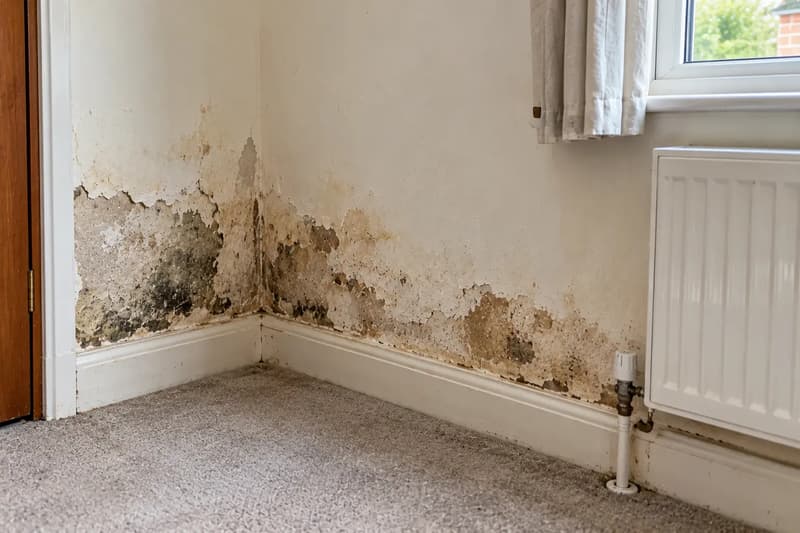
Damp confined to the base of a breast, close to the skirting, may have a different cause altogether. The breast is a solid mass of masonry, and any damp proof course has to run through it just as it does along the neighbouring walls. Where that barrier was never continued, or a raised hearth or floor now covers it, ground moisture can climb. A leaking pipe under the hearth or water collecting at the bottom of a blocked flue are worth ruling out too. Our guide to signs of rising damp covers the low-level pattern in more detail.
Shared stacks and party walls
In terraced and semi-detached houses, a single stack often serves both homes. A damp breast on your side may come from a defect on your neighbour's half of the stack or their flashing. Speak to them early, because a lasting repair may need both owners to agree on access and how the work is shared. If you rent, report chimney damp to your landlord in writing, with dated photos of how the patch has changed.
What affects the cost of fixing chimney damp
There is no single price for chimney damp, because the work depends on what is found. The main factors are:
- Which cause, or combination of causes, the inspection confirms
- Access to the stack, including roof height and whether scaffolding is needed
- The condition of the flaunching, pointing, pots and flashing
- Whether the flue needs a cap, a cowl or new vents
- How much salt-contaminated plaster has to come off, and on how many floors
- Making good and redecorating afterwards
Getting chimney damp checked
Ask for a written quotation that lists each part of the job separately, so you can see which work stops the water and which repairs the damage. Our damp proofing cost guide explains why an inspection comes before any figure.
Arrange a visit if the stain is growing, plaster is crumbling, a ceiling beside the stack is wet, or an earlier repair has not stopped it coming back. On a free homeowner damp survey we inspect inside and out, take moisture readings and explain which cause the evidence points to, followed by an honest recommendation and a written quotation for any work needed. Use the enquiry form to book, or read about our penetrating damp treatment.
Want a professional to handle it?
Arrange a survey to find out what your home needs.
Related services
Covering Ruislip, West London and South Bucks.
Questions about this topic
Can I paint over damp on a chimney breast?
Not until the cause is known. If rain is still getting in or salts are in the plaster, fresh paint will stain or blister again. Fix the source first, then choose a finish suited to it; see can you paint over damp walls?
Should a disused chimney be capped?
Capping keeps rain out, but a completely sealed flue can trap moisture. A ventilated cap at the top, paired with a vent at the old fireplace opening, lets air move through and helps the flue stay dry.
Why is my chimney breast damp when it has not rained?
Patches that darken in humid weather rather than after rain usually point to salts in the plaster pulling moisture from the air, or to condensation inside a sealed flue. Roof repairs alone will not cure either.
Is chimney breast damp the same as rising damp?
Usually not. Most chimney damp starts at the stack or inside the flue. If the damp sits only at the base near the floor, rising damp or a leak under the hearth should be checked.
Related guides
- Wet patches on walls
Reading a wet patch by height, shape and timing to tell rising damp, rain getting in and leaks apart.
- Salt on walls
Internal hygroscopic contamination, misleading readings and suitable salt-resistant finishes.
- Cracked render and damp
How cracked or hollow render lets rain in, why hard render traps moisture and how repairs are decided.